

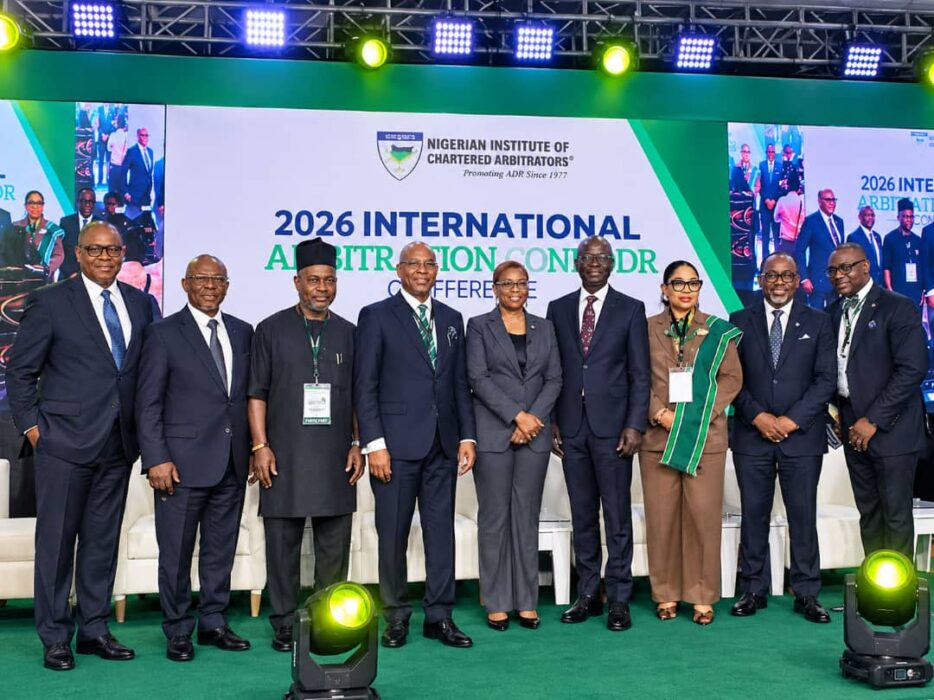
Former Vice President Prof. Yemi Osinbajo has warned that Africa risks turning the African Continental Free Trade Area (AfCFTA) into a fine document that fails in practice if it does not build a fast, affordable and trusted system for resolving commercial disputes.
Delivering the keynote address at the 2026 Annual Conference of the Nigerian Institute of Chartered Arbitrators (NICArb) in Lagos, Osinbajo, who was represented by the former Attorney-General and Commissioner for Justice in Lagos State, Mr Ade Ipaye, said the continent can no longer afford a system where its biggest disputes are decided abroad.
Speaking on the theme, Re-imagining Arbitration and ADR in Africa: Innovation, Integrity and Commercial Justice in a Changing World, he noted that for much of the last century, arbitration in Africa was largely something that happened to Africans rather than by them.
“For much of the last century, arbitration in Africa was largely something that happened to us rather than by us. Our disputes were exported to London, Paris, Geneva, Washington and Stockholm. The seats were foreign, the rules were foreign, the arbitrators were mostly foreign. We were consumers of a justice system designed for other people.”
He acknowledged that Nigeria has made progress with the Arbitration and Mediation Act 2023 and that credible seats are emerging in Lagos, Kigali, Cairo, Nairobi and Johannesburg. However, he stressed that progress is not arrival.
“The question is whether it is ready for what is coming. A world of digital commerce and artificial intelligence, of the AfCFTA, of energy transition and climate disputes, and of a younger generation who expect justice to move at the speed of their business.”
Explaining why dispute resolution matters to investment, Osinbajo said investors do not only ask whether a country has good laws. They also ask how long it takes and how much it costs to enforce a contract when things go wrong.
“Dispute resolution is not an afterthought to the economy. It is part of essential infrastructure as real as roads, electricity and broadband,” he said.
Turning to integrity, he cited the P&ID case, in which an award that had grown to over $11 billion was entered against Nigeria before the Commercial Court in London, which set it aside in October 2023 after finding it had been obtained by fraud.
“The process did not protect the integrity of arbitration. It was rescued at great cost, despite the process,” he said.
He further warned that while international arbitration has served large corporations well, it has failed the trader in Aba, the agro-processor in Tamale and the startup in Nairobi, the very businesses that will decide whether AfCFTA works.
“If a Nigerian supplier cannot enforce a contract against a Liberian buyer quickly and affordably, the free trade area exists on paper but not in the ledger where it matters,” he said.
READ ALSO:
- UNIABUJA Land Dispute – ASUU Opposes FCTA Reallocation
- 33 CSOs Back Customs CG Over Recruitment Dispute
- AA Leadership Dispute Takes New Turn As Omo-Aje Seeks To Withdraw Appeal
Osinbajo urged governments to treat dispute resolution as economic infrastructure, courts to be prompt and pro-enforcement while standing firm against fraud, and businesses to draft better clauses, consider mediation first, and choose African seats and arbitrators where possible.
“Whoever is equipped to resolve the disputes of the new economy will help to write its rules,” he said.
In his goodwill message, the Lagos State Attorney-General and Commissioner for Justice, Mr Lawal Pedro, who stood in for Governor Babajide Sanwo-Olu, said the theme is particularly relevant at a time when African economies are expanding commercial relationships and attracting greater cross-border investment.
He said businesses must have confidence that disputes arising from their transactions can be resolved fairly, efficiently and without unnecessary delay.
According to him, a strong economy requires more than good infrastructure and investment opportunities. It also requires credible institutions that protect commercial interests and uphold the rule of law.
He noted that this understanding has informed the State’s continued support for alternative dispute resolution institutions such as the Lagos Multi-Door Courthouse and the Citizens’ Mediation Bureau. He also recognised the important role of the Lagos Court of Arbitration in strengthening the commercial dispute resolution environment.
“As Africa pursues greater economic integration, we must continue to strengthen our arbitration framework, embrace appropriate technology and uphold the highest standard of professional integrity. Our ambition should be to make African jurisdictions increasingly attractive and trusted destinations for resolving commercial disputes.”
He commended NICArb for its longstanding contribution to professional development, capacity building and the advancement of arbitration practice in Nigeria and across Africa. He also encouraged the Institute to continue working with governments, the judiciary and the business community to develop practical solutions that will improve access to commercial justice and strengthen investment confidence.
In his welcome address, the President and Chairman of the Governing Council of NICArb, Mr Omoruyi Omonuwa, said arbitration in Africa must look beyond where it is today and focus on where it needs to be tomorrow.
He noted that AfCFTA, cross-border investment, digital commerce, infrastructure financing and the energy transition are creating new opportunities, but also more complex disputes. Businesses and investors, he said, now want dispute resolution that is fast, affordable, impartial and enforceable.
Omonuwa said Nigeria has taken a good step with the Arbitration and Mediation Act 2023, but the focus must now be on turning the law into real improvements in commercial justice.
He listed five key commitments for the future: innovation with principle, integrity and trust, inclusion and capacity building, judicial partnership, and commercial justice. According to him, Africa must move from just using international arbitration to becoming a trusted destination for it.
He therefore challenged participants to go beyond speeches and develop practical recommendations, clear responsibilities, and measurable actions that will make arbitration faster, more transparent, and more trusted by businesses and investors.

