

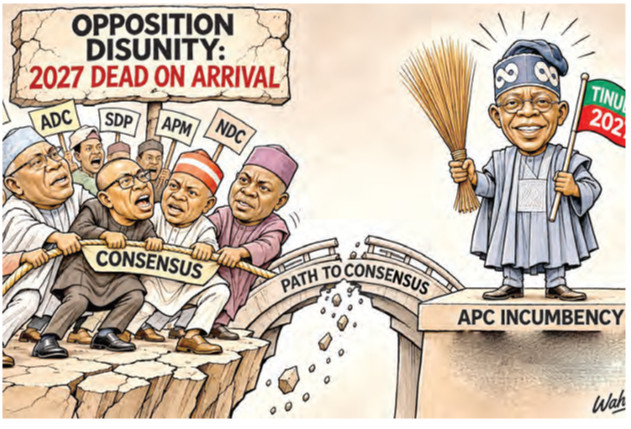
The race for 2027 is about to be sealed, as opposition parties plan to meet this Monday, 30th November, to agree on a presidential consensus candidate for next year’s general polls. Already, ahead of Monday’s meeting, the Allied Peoples Movement (APM) presidential candidate, Governor Seyi Makinde, has signalled his intention to step down for the crisis-ridden African Democratic Congress (ADC).
The drive for an opposition consensus gained momentum during the Abuja summit in August 2026, where groups like the G-100 initiative and various parties—the ADC, APM, a faction of the Peoples Democratic Party (PDP), Nigeria Democratic Congress (NDC), Social Democratic Party (SDP) and the Peoples Redemption Party (PRP), among others, began mapping out frameworks for unity. Prominent politicians have publicly implored contenders such as Atiku Abubakar, Peter Obi, and Adewole Adebayo to prioritise a unified ‘cabinet-in-waiting’ over individual ambition.
As It Is Now
Against the backdrop of a united candidate to contest the 2027 presidential poll, there is a consensus that, for the opposition to defeat the incumbent administration led by President Bola Ahmed Tinubu, it must reduce the 2027 presidential race to a two-horse race. The former Archbishop of the Abuja Archdiocese, John Cardinal Onaiyekan, has consistently maintained that without unity of purpose within the opposition, the prospects of defeating the incumbent are already dead on arrival (DOA). Citing what happened before 2015, pro-consensus-candidate advocates are leaving no stone unturned to repeat the opposition’s past success and unite behind a single candidate for the presidential election.
Considering the need to maintain the power-sharing formula between the North and South, many are calling for power to be retained at all costs. This call has become imperative, given former Vice President Atiku Abubakar’s determination to wrest power from the present administration. With the North as his support base, the former vice president’s ability to mount his last presidential bid is being weakened by the constant reminder that power must reside in the South, and that if Atiku wants power, he must wait for the North’s turn in 2031. With the retired Customs officer turning 80 this week, he may reject calls to withdraw from the race and wait for 2031, when he will be 85.
READ ALSO:
- Opposition Coalition Affirms Nov 30 Summit, Unveils 3 Key Documents On Democratic Renewal
- Makinde Says Opposition Coalition Will Emerge To Remove Tinubu In 2027
- Cross River Council Chairmen Rally Behind Otu, Attack Opposition
Opposition’s Roadblock
Even as the opposition stands committed to defeating Tinubu next year, clouds of uncertainty remain. Unlike in 2023, when religious factors were deployed during the polls, religion has become less attached to the campaigns. Despite the same-faith ticket of the All Progressives Congress (APC), many non-Muslims have come to accept the ticket as a strategy and have nothing to do with availing or denying Christians their rights. The softening of positions on the Muslim-Muslim ticket is reflected in the performance profile of the Tinubu administration, which its former supporters are accusing of favouring more Christians in appointments. Coupled with strident criticism by former allies and groups that formed the fulcrum of the 2023 campaigns that ushered in the Tinubu presidency, the threats of national religious conflagration have receded in intensity, leaving out easy dialectics for the incumbent to swing to victory.
If the South is to complete what is rightly its own, the politics of 2031 has overwhelmed future postulations. With the nomination of Sen. Rabiu Musa Kwankwaso as the vice-presidential nominee, it’s clear that the North-West is poised to have the next president. Kwankwaso has declared that his presidential candidate, Peter Obi, has agreed in writing to a single-term presidency. If that scales through, the leader of the Red Caps is set to assume the presidency in 2031. It’s not a permutation many in the North-East and North-Central would gladly embrace. Perhaps that’s why the NDC has seen eruptions of disagreement, with some top officials throwing in the towel to defect to other parties and assume positions. The NDC shows signs of desperation as the party’s bright prospects dim amid the current upheaval in Kano. Kwankwaso must show himself to be the strongman of Kano politics. As it stands, next year may cast a shadow over Kwankwaso’s capacity to remain the ultimate decider.
Determined But Disunited
The drumbeats of 2027 are drawing close, but the opposition is filled with an unquenchable thirst to defeat Tinubu, with no strategy. Unlike in 2015, the opposition is disunited, with formidable candidates insisting on their own way if they are denied consensus. Atiku is convinced of victory in the next year, just as Kwankwaso has said his boss cannot step down for Atiku. Personal greed for power and the determination to go it alone remain the opposition’s greatest albatrosses in its plot to end Tinubu’s presidency. Unlike in 2015, when all resolved to stand behind Major General Muhammadu Buhari to defeat President Goodluck Jonathan, the race for the 2027 presidential poll is anchored in a grab for power, not for the Nigerian people. A disunited opposition lacks the firepower to defeat an incumbent, and no election has been won on anger alone.
As the Independent National Electoral Commission (INEC) finalises its candidate list for January 16, 2027, consensus would no longer mean a single name on the ballot. Instead, it would require major nominees to halt active campaigns and ask supporters to back a rival party, posing massive voter-education and logistical hurdles. In the last two to three months, disagreements over who should helm the ticket have paralysed talks. It’s clear that, without an eleventh-hour realignment, the opposition enters the final stretch of the race fragmented, setting the stage for a multi-candidate contest against the APC. Less than two months before the commencement of the 2027 polls, the incumbent has thrown everything into the fire by promising an improved future for citizens. The APC has continued to get endorsements from critical stakeholders ahead of the polls. If the opposition must offer a flicker of hope, it must repeat what happened in 2015. Sadly, the prospects for defeating Tinubu grow dim in the face of a disunited opposition that is enmeshed in fighting itself for dominance.

