

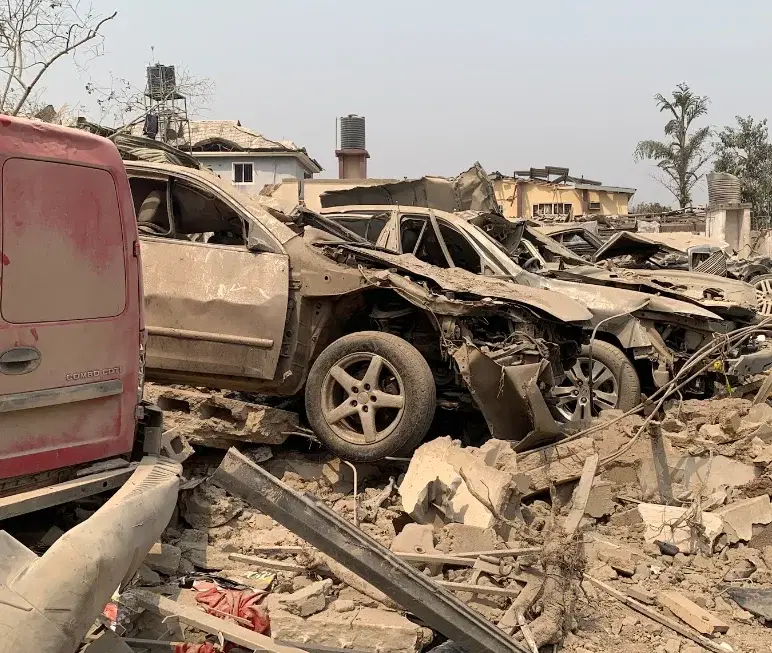
Victims of the January 16, 2024, Bodija explosion in Ibadan, Oyo State, have appealed to the federal government to release the outstanding N20 billion intervention fund, insisting that the money should be paid directly to affected residents rather than channelled through their association.
The affected residents, under the aegis of the Bodija Residents Association (BERA), also called for a review of the compensation exercise, alleging that the N4.085 billion already distributed by the Oyo State Government was inadequate and that several victims were excluded.
The appeal follows Governor Seyi Makinde’s recent disclosure that his administration had expended the N30 billion intervention fund released by the Federal Government to the state following the explosion.
BERA chairman, Muyiwa Bamgbose, said the association’s assessment of the damage, conducted with the assistance of professionals, put the cost of restoring affected buildings and replacing destroyed vehicles at more than N10 billion.
He said the N4.085 billion distributed by the state represented only about 40 per cent of the losses assessed by the association.
According to him, the state government reduced the assessed claims, citing financial constraints, while some victims were excluded because their properties were considered outside the designated impact area.
Bamgbose said the association was appealing to the federal government to release the remaining N20 billion from the N50 billion intervention fund reportedly promised to Oyo State.
“The governor has said that N30 billion has been expended. We are appealing to the federal government to release the remaining N20 billion and look at the records we drew up,” he said.
He, however, clarified that BERA was not seeking to receive the money on behalf of the victims, proposing instead that the Federal Government verify the association’s records and pay affected residents directly.
“We don’t want the money to come to BERA. We can provide the federal government with the records of victims, and the money can be paid directly to the affected victims,” he added.
The association chairman said the compensation exercise failed to reflect the actual losses suffered by several residents, noting that some victims had to rebuild their homes with personal funds after receiving inadequate financial support.
He urged the government to revisit the initial assessment and reconsider the amounts deducted from victims’ claims.
Bamgbose also disclosed that the association had forwarded complaints from residents who allegedly received no financial assistance to the state government for further consideration.
While acknowledging the state’s road rehabilitation projects following the explosion, he insisted that the immediate welfare of displaced residents should take priority.
“Doing the road is good, but the priority should be for people to have habitable abodes,” he said.
Some residents affected by the explosion also expressed dissatisfaction with the compensation received, describing the payments as inadequate compared with the damage to their properties and personal belongings.
One of them, Mohammed Danesi, who lived close to the epicentre of the explosion, said he received about N1.4 million despite losing virtually everything.
Danesi disclosed that he and his two children were admitted to a private hospital after the incident, adding that the family incurred medical expenses.
According to him, the family was subsequently instructed to submit its medical bills to the state Ministry of Health for possible reimbursement but had yet to receive payment.
“We complied, and nothing has been received to date,” he said.
Another victim, 88-year-old Dr Akinyele Coker, who lives on Aderinola Street, said the amount he received represented about 40 per cent of the losses assessed by BERA.
Coker described himself as fortunate because he had personal savings with which he could rebuild his property. He added that only two residents on his street had been able to reconstruct their homes, relying on personal resources to supplement the government’s assistance.
Similarly, Toyin Olujumi said she received compensation about two to three weeks before the interview but claimed the amount was N15 million below the value of her losses as assessed by BERA.
She also faulted the distribution process, alleging that some people whose houses were not affected received substantial payments, while tenants who suffered considerable losses received relatively small amounts.
Olujumi, however, acknowledged the state government’s intervention, saying affected residents needed support to rebuild their lives after the tragedy.
The appeal comes after Makinde disclosed that his administration had spent the N30 billion intervention fund received from the Federal Government.
The governor made the disclosure during an interview on Arise Television, explaining that the state engaged the Nigerian Society of Engineers and professional valuers to assess properties affected by the explosion before making payments to their owners.
Makinde said the funds were initially kept in a bank account while his administration awaited what he described as attempts to use the federal government’s intervention to politically blackmail him.
READ ALSO:
- ADC Challenges Tinubu Over Alleged $4.5m Payment To US Lobbyist
- Benue Police Neutralise 3 Suspected Bandits, Rescue 5 Kidnap Victims, Arrest
- Insecurity: Reps Demand Urgent Review Of NYSC Mobilisation, Deployment

