

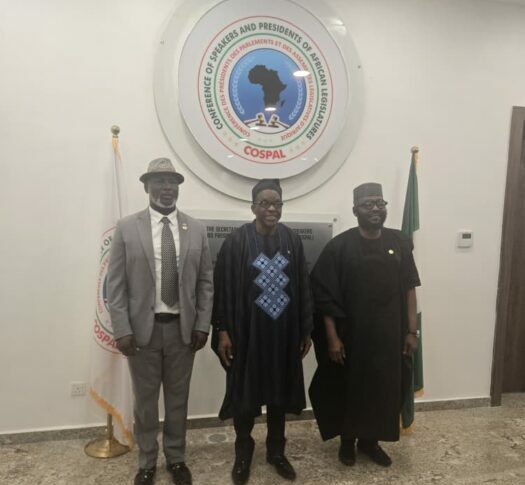
African Parliamentarians have ramped up efforts to boost the continent’s $3 trillion common market through the harmonization of legislative actions, robust law and diplomacy to ease the movement of people, goods and services.
This has become incumbent on the legislative leaders as the fourth General Assembly of the Conference of Speakers of African Parliaments (CoSPAL) scheduled for Monrovia, Liberia between December 9 and 11, 2026 offers another opportunity to interrogate the prospects and challenges of development especially in critical sectors that will shape the future of the continent.
CoSPAL chairman and Speaker of the Parliament of Ghana, Rt. Hon. Alban Bagbin, was emphatic when he told a news conference in Abuja on Friday that Africa’s $3 trillion common market of 1.4 billion people across 54 countries cannot be achieved by executive declarations alone but by strengthening national parliaments through peer-to-peer learning and enacting model laws that would translate the African Union’s Agenda 2063 into practical reality.
Africa has suffered decades of post-independence fragmentation, which has culminated into legal and non-tariff barriers across borders, impeding the free movement of goods, capital, and citizens. It is therefore necessary that the Monrovia Assembly will be a critical point of collective action and policy reviews.
“Integration cannot be realized only at the top; it must start from the bottom,” Bagbin said. “If you have different countries making different laws, you definitely will have problems with integration, with free trade, with movement, and with the infrastructure that we are talking about. But if we are able to come together, harmonize, and have model laws which we all enact, definitely you will have all these barriers being a thing of the past.”
The Monrovia conference is billed to deepen discussions on cross-border infrastructure projects such as the West African Gas Pipeline and plans to expand gas and solar energy networks across the continent. This, according to the CoSPAL chairman, must involve making parliaments in the region to enact enabling legislation and exercise rigorous oversight to ensure public resources are prudently utilized.
CoSPAL’s network’s reach across francophone, lusophone and anglophone parliaments is meant to help Africa speak with one voice. The goal is to agree a common position before the World Conference of Speakers, where African lawmakers can then have greater influence.
CoSPAL complements the executive arm of government rather than competing with it, with parliaments well placed to tap citizens’ collective wisdom and pass it to those implementing policy.
READ ALSO:
- AFRICANDO 2026: Otti Urges Africa To Reduce Dependence On Foreign Aid
- South Africa’s First Female Deputy President, Phumzile Mlambo-Ngcuka, Dies At 71
- Women Miners Demand Action Plan On West Africa’s Mineral Wealth
“This is to make democracy tick in our continent,” the chair said.
Also speaking during the conference, Speaker of the House of Representatives of Liberia, Rt Hon. Richard Nagbe Koon appreciated the enormity of the task ahead of the continent’s leaders even as he assured that the December General Assembly offers Africa’s oldest republic an opportunity to showcase its investment potential, hospitality, and commitment to continental integration.
For the Liberian Speaker, the f Fourth General Assembly would seek a shared path on investment, infrastructure and economic development as African countries look increasingly to one another as partners in trade, investment, innovation and development.
“We want this conference to be productive, substantive and to reflect Africa’s shared aspirations,” he said, adding that Liberia would use the occasion to showcase its hospitality, investment potential and commitment to African integration.
CoSPAL Secretary-General, Amb. ’Dapo Oyewole, outlined key institutional programmes driven from the Abuja Secretariat ahead of the Monrovia Declaration, which will follow earlier declarations adopted in Abuja, Rabat, and Accra.
Among the flagship initiatives, Oyewole highlighted the Women’s Representation in African Parliaments (WRAP) programme and the African Gender Legislative Agenda, which provide frameworks for parliaments to close gender representation gaps.
He also pointed to the expansion of the Legislative Mentorship Initiative (LMI)—originally founded by former Speaker of Nigeria’s House of Representatives, Rt. Hon. Femi Gbajabiamila—into a continental programme under CoSPAL. According to Oyewole, 50 young fellows currently undergoing training at the Secretariat will graduate on Friday, bringing total alumni to 268, with dozens already serving in the Office of the President, federal ministries, and the National Assembly.
“If we want to shape the future, we have to start now by training these young people,” Oyewole said, adding that CoSPAL has also launched the African Legislative Research and Knowledge Management Network, initiated work on artificial intelligence governance in legislatures, and entered talks with the Commonwealth Election Observation Mission to train parliamentary staff for continental election observation.

