

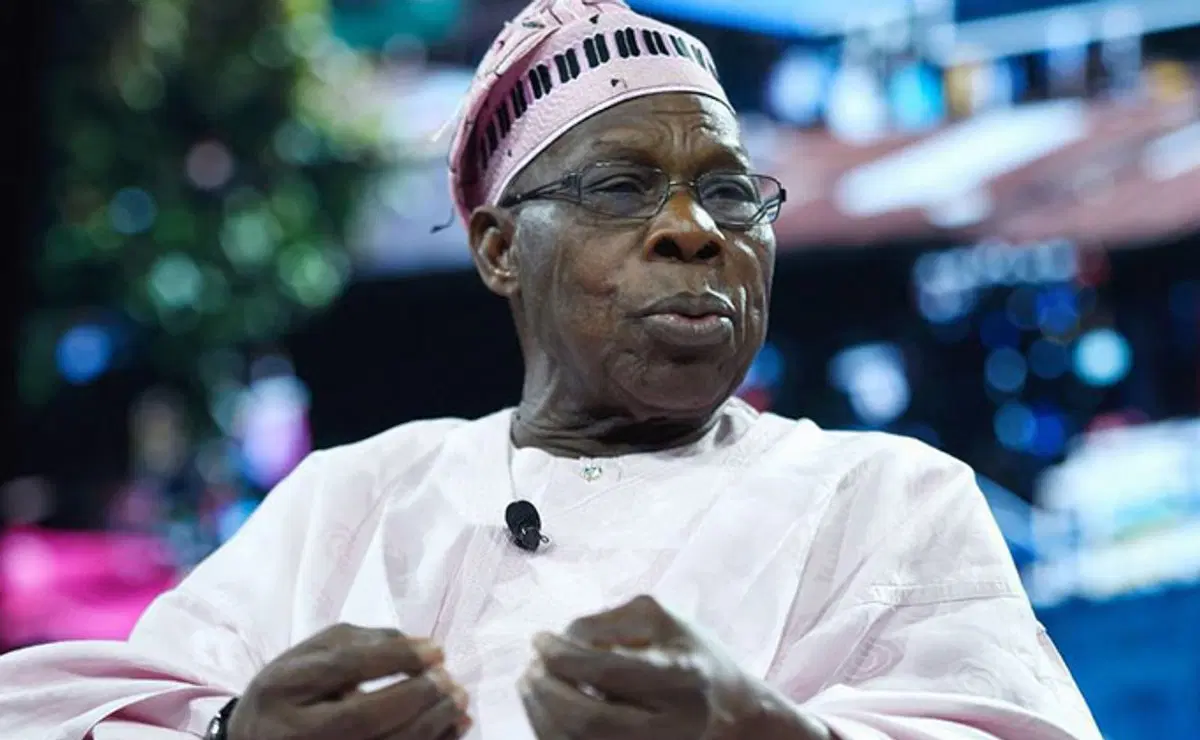
Former President Olusegun Obasanjo’s criticism of President Bola Tinubu’s foreign exchange reforms has reignited debate over the impact of naira devaluation on Nigerians’ purchasing power.
Experts within the country and abroad, labour activists and civil rights advocates have joined him in faulting the policy, saying it has deepened economic hardship despite signs of improved corporate performance and macroeconomic stability.
Obasanjo spoke on Wednesday at the Financial Times Africa Summit 2026 in London, United Kingdom (UK), where he blamed the sharp depreciation of the naira for eroding household incomes and worsening poverty. He said the currency’s devaluation had contributed to the country’s position as the world’s poverty capital.
“We do not live in isolation as a country. We interact with the rest of the world. And overnight, you devalue the currency by 300 per cent. The naira went from N500 to a dollar to N1,500 to a dollar,” he said.
“What that meant was that every Nigerian is made poor by 300 per cent. That made Nigeria become the poverty capital of the world, which means Nigeria has the largest number of poor people in the world.
“You cannot say to me that that is good for Nigeria. You cannot say to me that that is good for us in any sense.”
President Tinubu announced the removal of the petrol subsidy at his inauguration in May 2023, a move that led to higher petrol prices and transport costs nationwide. In June 2023, his administration introduced foreign exchange reforms that allowed the naira to trade more freely, collapsing the multiple exchange-rate system and narrowing the gap between official and parallel market rates.
According to the administration, the measures were aimed at addressing longstanding distortions, improving market efficiency, attracting foreign investment and strengthening the economy.
However, the reforms coincided with a sharp depreciation of the naira and a surge in inflation, raising the cost of imported goods, production inputs, food, transportation and other essential commodities. The price increases have continued to erode citizens’ purchasing power and put pressure on household budgets and businesses.
Experts back Obasanjo
A professor of law and developmental economist, Prof. Tayo Bello, backed Obasanjo’s position, saying the devaluation had significantly reduced Nigerians’ purchasing power and undermined the value of wage increases.
According to him, the purchasing power of workers earning the former N18,000 minimum wage was, in real terms, stronger than that of many workers earning the current N70,000 minimum wage.
“What matters in any nation or economy is the purchasing power of that particular currency. The value of the naira has nosedived; do not forget that we are an import-dependent country and consume a lot of foreign goods. When people were earning N18,000, they were far better off than when it was increased to N70,000,” Bello said.
He blamed the hardship partly on the manner in which the reforms were implemented, arguing that the removal of subsidies should not have been accompanied by such a sharp adjustment in the exchange rate.
“The problem the country has faced, and the problem the present administration created, was as a result of a shortcut. I am an advocate of subsidy removal, but I did not suggest it in that way. If they had removed the subsidy alone, without tampering with the naira, both the country and the citizens would have benefited,” he said.
Bello also cited the burden of debt servicing as evidence of the broader difficulties facing the country.
“So, it is a problem. Apart from what he (Obasanjo) is saying, the problem we are facing is that we have too many economic problems. The World Bank had mentioned that we are servicing debt with more than our revenue. Obasanjo will not be the only person to say it. Other people too have said it, but they are afraid because they do not want to be castigated,” he said.
Public affairs analyst Dr Katch Ononuju said the former president was 100 per cent correct in his description of the poverty the reforms have inflicted on Nigerians in the last three years. He admitted, however, that there was nothing inherently wrong with fuel subsidy removal and the subsequent naira devaluation. His concern was the lack of transparency and accountability, as he alleged that the savings from subsidy removal had been stolen.
“Subsidy removal and floating the naira is good, but the problem is the absence of trust. We don’t know where the savings are. The savings are being stolen,” he said.
A Professor of International Relations and a member of the Directing Staff at the National Institute of Security Studies, Prof Mukthar Imam, told on Thursday that Nigeria’s current economic reality does not warrant devaluation.
“We don’t need devaluation because our purchasing power parity is not significant. We have devalued the currency in this country about 14 times before and failed because we have not put mechanisms in place to address the matter,” he said.
He added that apart from headline inflation, Nigeria also has food inflation, which he described as “double-edged inflation.” He pointed out that countries embark on devaluation when they are producing more goods through manufacturing to sell to the world, stressing that Nigeria does not have adequate production capacity and therefore does not need to devalue its currency.
He alleged that the Tinubu administration is just playing the script of international financial institutions to curry their favour; otherwise, it does not make any economic sense to devalue the currency at this time.
An expert in international finance, who preferred anonymity, described the devaluation as devastating for citizens, saying it has reduced purchasing power, lowered real wages and living standards, and made food and other essential items very costly. He added that it has reduced investors’ confidence, prompting them to withdraw funds from the system as companies move away from the country, leading to increased joblessness.
Labour and activists: “The indices are everywhere”
A member of the Nigeria Labour Congress (NLC) and civil rights advocate, Comrade Stevens Parker, said Nigerians did not need Obasanjo to tell them that their living conditions had deteriorated.
“It is not even Obasanjo who will remind Nigerians that they are poorer today than at any time in the history of their development. The everyday existence of those living in Nigeria paints a disturbing picture of destitution and misery. The indices are everywhere you look,” Parker said.
He, however, distinguished between the removal of the petrol subsidy and the government’s failure to address longstanding structural problems, including alleged corruption and the mismanagement of public resources.
“For me, the subsidy removal is not the problem. However, the failure of the government of the day to tackle the hydra-headed problems long entrenched in the very fabric of the country leaves no room for cheer,” he said.
Parker noted that although the government had described the subsidy regime as a scam, Nigerians were yet to see sufficient accountability for those allegedly responsible.
“They gleefully come out to say that subsidy is a scam. That’s absolutely correct! But what have they done to contain it? Were the transactions made to ghosts? Those behind the heist are walking free, while millions of innocent citizens are paying for the SINS they did not commit. The average Nigerian is going through so much at the moment,” he said.
While acknowledging that the country’s economic problems predated the Tinubu administration, Parker said the burden of the reforms had fallen disproportionately on ordinary citizens.
“Yes, the problems bedevilling the country were not created by President Tinubu. Notwithstanding, the body language suggests that Nigerians have to swallow the hard pill for recovery.
“Is this the best way to appreciate those who supported his candidacy and went on to vote him to power?” he asked.
Civil rights activist Comrade Abosede Busayo Oluwaseun said the depreciation had imposed significant hardship by raising the cost of basic goods and services.
“The naira devaluation has imposed a very clear significant hardship on Nigerians. The decline in the naira’s purchasing power has increased the cost of food, transportation, housing, and other essential goods and services, leaving many citizens poorer in real terms aside from the government’s economic terms,” she said.
Oluwaseun argued that the success of economic reforms should be measured by their impact on the living conditions of ordinary citizens rather than by improvements in macroeconomic indicators alone.
“Policy success should ultimately be measured by improvements in the living conditions of ordinary Nigerians. Unfortunately, many citizens have not felt the benefits of these policies,” she said.
She called on the government to introduce urgent measures to reduce inflation, strengthen the naira, create jobs and cushion the effects of rising living costs on vulnerable households.
“I believe the government must urgently introduce effective measures to reduce inflation, strengthen the naira, create jobs, and ease the burden on vulnerable households. Economic reforms should not focus on economic terms, it must translate into tangible improvements in the lives of the people,” she said.
The other side: stability and profits
Not everyone agrees. A Nigerian in the diaspora, Comrade Jide Akala, said the reforms should be assessed against the broader economic outlook and the views of international financial institutions.
“Well, Obasanjo is following the statement by the IMF and World Bank praising the policy. The economy is stabilising, foreign investors are coming in, and the stock market is doing well. I think Obasanjo should reset and accept the statement by IMF and World Bank as the true statement,” Akala said.
The national chairman of the New Dimension Shareholders Association, Patrick Ajudua, said the initial impact of the devaluation included foreign exchange instability and exchange losses for many companies. He said subsequent adjustments, higher international oil prices amid the Middle East conflict and lower production costs following foreign exchange stabilisation had since improved corporate performance. According to him, many companies are now declaring profits, paying dividends and recording capital appreciation in their shares.
Ajudua, however, said the gains had yet to reach ordinary Nigerians.
“This has not actually translated in practical terms to improvement in the life of citizens as these companies have transferred high product costs to consumers, leading to more economic hardship and high cost of living,” he said.

