

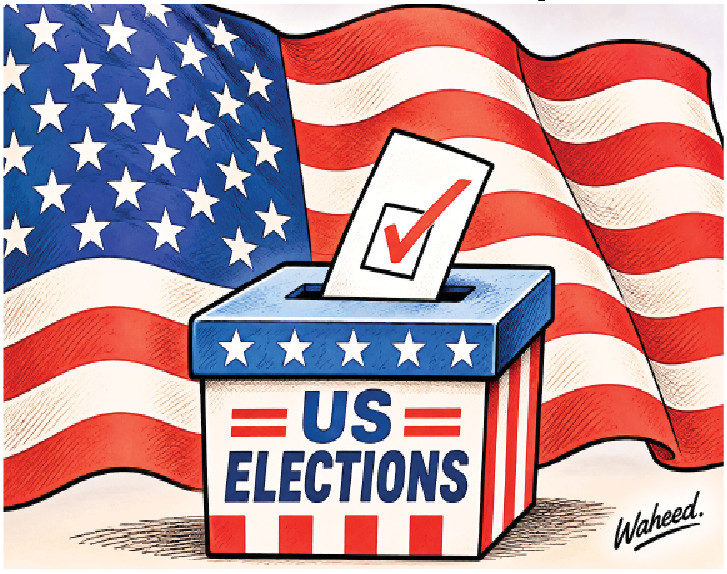
An Analysis of The US Midterm Elections and Lessons for Democracy and Accountability
The Ballot as an Audit
The most revealing message from America’s November 3 midterm elections may not be that Democrats won control of both chambers of Congress. It is that voters turned an election usually treated as a referendum on the president into an audit of power. They measured promises against performance, public duty against private interest, and the cost of governing against the burden on ordinary households. Then they demanded an account.
The result was a sharp rebuke of President Donald Trump and his Republican Party. Democrats gained in states long regarded as Republican territory, including Texas and Kansas. Cost of living, the unpopular war with Iran, and concern about government corruption helped drive the verdict. Exit polls found nearly nine in ten voters considered affordability a major factor, while many wanted stronger congressional checks on the president. This was not simply a partisan wave. It was an insistence that power must explain itself.
Elections are often described as the people choosing a government. In a functioning democracy, they are also the people reviewing one. Citizens are not customers selecting a political brand; they are principals assessing agents entrusted with public authority. The midterms showed that even a president elected nationally can face consequential judgment before the next presidential contest. The calendar does not suspend accountability.
When Grievance Becomes a Verdict
The familiar analysis will focus on inflation, turnout, campaign strategy and the electoral map. Yet the less discussed lesson is how grievances converged into a judgment about government’s character. Economic hardship is not a spreadsheet. It is a household unable to stretch wages, a family facing higher fuel and food costs, or a citizen wondering why public resources serve those already near power.
Corruption is not only the theft of public money; it is the belief that rules are written for the powerful and enforced against everyone else. When leaders appear to put personal interests above the national interest, even competent policy announcements lose credibility. Trust is a governing resource. Once depleted, every decision costs more to explain and every sacrifice becomes harder to request.
The result should not be romanticised as a uniform uprising or an endorsement of every Democratic proposal. Voters can reject an incumbent without embracing the alternative. The Democrats’ victory gives them responsibility, not immunity. If their new congressional power becomes spectacle, revenge or partisan investigations, they may squander the central demand: that government work, disclose and answer.
Accountability is not the day after election night, when the defeated concede and the victor celebrates. It is the discipline that follows: budget scrutiny, oversight of executive decisions, transparent procurement, credible investigations and consequences for misconduct. An election opens the door. Institutions must keep it open.
Nigeria’s Approaching Test
For Nigeria, where the next general election is due in 2027, the American result is neither a template to copy nor a foreign lecture to dismiss. Our systems differ. But the democratic question is familiar: can voters turn frustration into a peaceful, credible and consequential verdict?
Nigerian citizens have grounds to demand answers. Cost of living, insecurity, unemployment, public service failures and the distance between political privilege and everyday hardship are defining concerns. Yet campaigns invite voters to choose personalities, regional calculations or party loyalties, treating performance as secondary. The US midterms remind us that the powerful question is not “Who is our person?” but “What has this government done, for whom, and at whose expense?”
READ ALSO:
- 2027 Elections: INEC Removes 1.6 Million Ineligible Names, Sanctions 54 Officials
- IGP Warns Politicians Against Destroying Opponents’ Billboards Ahead of 2027 Elections
- 2027 Elections: APC’s 13m Membership Gives Party Winning Edge, Yilwatda Says
Incumbents at every level should be judged against clear commitments: jobs, schools and hospitals, security, infrastructure, fiscal choices and integrity in public spending. Opposition parties must do more than catalogue failures. They need credible alternatives, policy discipline and internal accountability. A change of party is not automatically a change of political culture.
Participation matters. The ballot cannot hold leaders accountable if citizens are discouraged, disenfranchised, bought off or made to fear violence. Credibility depends on the entire chain: registration, transparent administration, accessible polling, protection of election workers, timely and verifiable results, and lawful dispute resolution. Political actors must not treat the electoral commission as an opponent to capture, or the judiciary as a shortcut to overturn the people’s decision.
Voters must resist immediate inducement. A bag of rice or temporary cash may soften a day’s hardship but cannot repair four years of neglect. The price of a vote is not the amount handed over; it is the public future surrendered. When citizens are asked to endure hardship in the name of reform, leaders must explain who bears the burden, what relief is planned, and when results can be measured.
The Opposition Is Not the Answer by Itself
A danger in interpreting the American result is assuming electoral defeat cures corruption. It does not. Opposition parties can reproduce patronage, opacity and impunity. New majorities can protect allies, weaken watchdogs or turn oversight into theatre. Renewal depends not on who occupies the seats, but whether the rules bind them.
The US Congress has an opportunity to restore checks and balances through oversight. The test is whether scrutiny is evidence-led, investigations follow due process, and findings produce reforms rather than headlines. The victors must show accountability is a principle, not a weapon reserved for opponents.
Nigeria should take this lesson before, not after, 2027. Strengthen independent institutions; protect auditors, journalists, civil society and whistleblowers; publish usable budget and procurement data; and ensure anti-corruption agencies act impartially. Parties should disclose candidate selection and funding. Legislatures must treat oversight as a constitutional duty, not a bargaining chip. Promises should be specific enough to assess.
A Global Warning and an Opening
The global implications reach beyond Washington and Abuja. Democracies face leaders who personalise power, discredit scrutiny and frame criticism as disloyalty. Elections remain essential but are increasingly asked to do the work of institutions weakened between them. The midterms show voters can still impose a check and how vital it is to preserve channels through which dissatisfaction becomes a legitimate outcome.
A warning to governments: economic pain and ethical failure are connected. When corruption appears to flourish as citizens make sacrifices, legitimacy erodes. A warning to opposition movements: public anger is borrowed, not owned; convert it into responsible governance. And a warning to institutions: neutrality, transparency and independence cannot be improvised during an election crisis. They must be built and defended daily. The reverberations will reach leaders and citizens far beyond America’s borders.
For Nigeria, 2027 must be more than a contest over who gets power. It should be a public audit of what power has done. The United States has reminded the world that elections have consequences—not because voters always choose perfectly, but because they retain the right to revise their choice. That right is democracy’s heartbeat.
For Africa, the message is clear: elections must become instruments through which citizens reclaim accountability, challenge impunity and remind those in power that no government is bigger than the people it serves.
The midterms’ final measure will not be the seats Democrats gained or Republicans lost. It will be whether the result produces more accountable government. Nigeria’s democratic future, likewise, will not be secured by changing faces alone. It will be secured when leaders understand office is temporary, public resources are held in trust, and citizens are not spectators to governance.
An election is not a blank cheque. It is a deadline for delivering an account of stewardship to citizens.

