

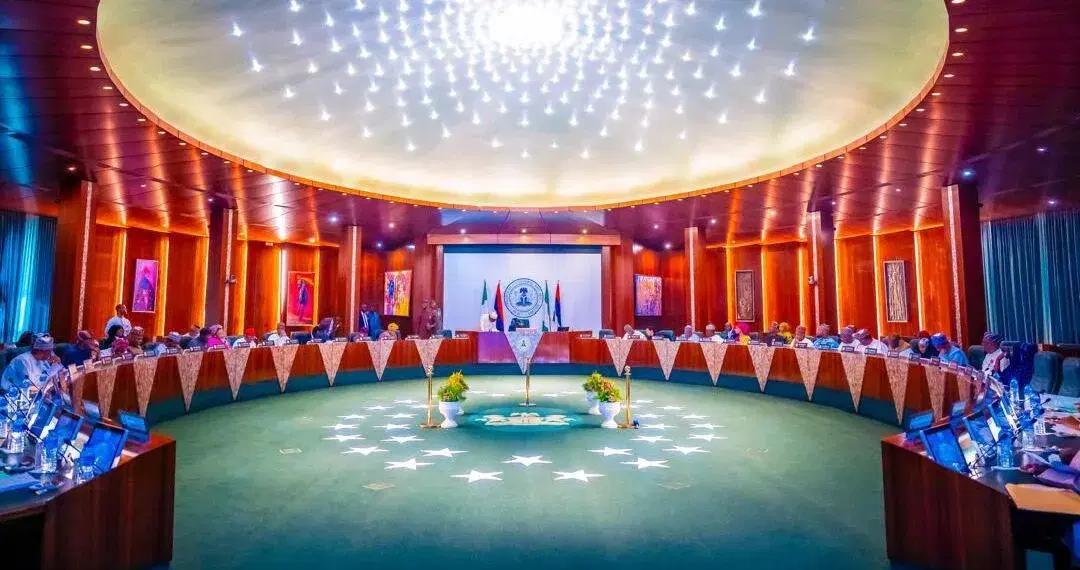
The Federal Executive Council (FEC) has approved approximately N2.078 trillion for road infrastructure in 10 states as part of the Federal Government’s drive to expand and modernise Nigeria’s transport network.
The Federal Executive Council (FEC) has approved 23 major road projects across Adamawa, Taraba, Ebonyi, Kwara, Cross River, Kogi, Lagos, Niger, Oyo and Plateau states, Minister of Works, David Umahi, told State House Correspondents yesterday.
He said the programme targets construction and rehabilitation of strategic corridors to boost connectivity, ease the movement of people and goods and stimulate economic activity.
FEC also ratified a presidential approval to augment by N15 billion, a road contract awarded in 2022 in Gashua, Yobe State, due to higher costs of construction materials, Umahi said. The council also approved N15.246 billion for Phase II of the Yola–Fufore–Gurin Road after the completion of Phase I.
Umahi said the FEC approved the full business case for its operation and maintenance under a modified Swiss challenge procurement, on the Lagos–Ibadan Expressway.
The ministry was directed by President Bola Tinubu to proceed with the procurement for the reconstruction of the deteriorating portions using the concrete pavement technology to improve safety and increase the longevity of the roads.
The council also approved the reconstruction of approximately 400.9 kilometres of federal roads under a tax credit arrangement to be executed by the Dangote Group at a cost of N1.8325 trillion. The package replaces a previous 2022 contract and is anticipated to expedite the delivery of critical road infrastructure.
Umahi added that the first 118-kilometre section of the Abuja-Kaduna-Kano highway, valued at N137 billion was completed while the remaining 164 kilometres were due for completion in November.
In a separate development, the Federal Government approved N34.398 billion for the construction of an airstrip in Gboko, Benue State.
Festus Keyamo, Minister of Aviation and Aerospace Development, said the contract was awarded to CCECC Nigeria Limited. The facility would support agricultural operations, bolster security and support humanitarian and emergency medical services in the region, he said.
The Council also approved maritime infrastructure and safety projects worth about N286 billion to modernise port operations, enhance maritime safety and protect Nigeria’s marine environment.
The Minister of Environment, Balarabe Lawal, who represented the Minister of Marine and Blue Economy, Gboyega Oyetola, said the council approved four strategic initiatives to enhance port efficiency, navigational safety and environmental protection in coastal and inland waterways.
The FEC approved the procurement of two pollution-control vessels at a cost of about N59.05 billion to tackle plastic pollution and other marine waste in Nigerian waters, creeks and inland channels, and to enhance navigational safety, he said.
The council also approved the purchase of six pilot cutter boats for N80.03 billion. The vessels will bring marine pilots to and from ships, aid navigation through port channels and help with coordination with the Nigerian Ports Authority.
The FEC also approved two firefighting boats valued at about N34.06 billion (about US$16 million) to improve emergency response to fires on vessels, oil terminals, jetties and other port facilities.
The council approved N112.85 billion for capital and maintenance dredging of the Escravos Channel under a public-private partnership between the Nigerian Ports Authority and private sector operators, Lawal added. The dredging is aimed at enhancing access to the channel, removing obstacles, enhancing pollution surveillance, maintaining navigational aids and enhancing overall maritime safety and efficiency.
The minister said the four approvals were a strategic investment in the Nigeria’s blue economy to improve navigational safety, enhance port performance, protect the marine ecosystem and create economic opportunities.

