

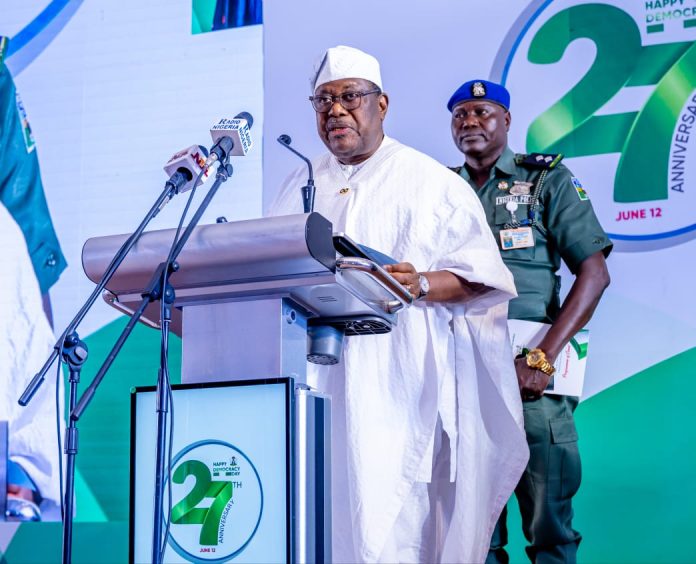
As Nigeria marks 27 years of uninterrupted democratic governance, the Nigerian Government has reaffirmed its commitment to deepening democracy, strengthening institutions and promoting national cohesion.
This was disclosed at a Democracy Day Public Lecture in Abuja, where stakeholders and policy experts reflected on the country’s democratic journey, achievements, challenges and future prospects.
The Secretary to the Government of the Federation (SGF), Senator George Akume who represented Nigeria’s Vice President Kashim Shettima, said the occasion provided Nigerians an opportunity to celebrate democratic gains while critically examining the nation’s progress since the return to civil rule in 1999.
He said Nigeria’s democratic journey has been about resilience and determination in the face of many challenges.
“Since 29 May 1999, Nigeria has returned decisively to democratic governance. “The main thing I’ve learned from this journey is that it’s been one of resilience and determination,” he revealed.
The country had successfully conducted eight successive general elections and witnessed peaceful transfers of power across political parties and regions, he said describing the development as evidence of the growing maturity of Nigeria’s democracy.
“The gains of democracy, the freedom of choice to vote and be voted for, remain priceless. We must continue to strengthen our institutions and ensure that democracy brings benefits to all Nigerians, he noted.
The SGF also stressed the need for national unity and cautioned against ethnic, religious and regional divisions.
“We should not let ethnic religious or regional fault lines undermine the foundations of our democracy. “National cohesion is vital to our survival and development as a democracy.”
The Director-General of the National Institute for Policy and Strategic Studies (NIPSS), Professor Ayo Omotayo, who delivered the keynote lecture, titled ‘Twenty-Seven Years of Democratic Governance in Nigeria: Achievements, Challenges and the Road Ahead’, described June 12 as a watershed moment in the country’s democratic history. As we honor the heroes of the June 12 struggle, especially the late Chief M.K.O. Abiola and other pro-democracy activists who made sacrifices for the restoration of democratic governance.
“Democracy Day is more than a holiday. It’s a sober reminder of the sacrifices made by brave Nigerians who believed that the destiny of this nation should be decided through the ballot, not the bullet,” Omotayo said.
The Director-General of NIPSS listed some of the achievements since 1999 to include, stronger democratic institutions, broader civic engagement, economic reforms, technological progress and increased global acknowledgment for Nigeria.
One of the most significant landmarks for him was the peaceful exchange of power among political parties at the federal level in 2015.
He emphasized that “the transfer of power from one political party to another is still one of the strongest indicators of the growing maturity of our democratic system.”
Professor Omotayo equally commended the growth of Nigeria’s digital economy, saying technology had become a major driver of innovation, entrepreneurship and financial inclusion.
The rise of the digital economy is one of the great accomplishments of democratic governance. “Young Nigerians are increasingly using technology to create businesses, generate employment and drive innovation,” the NIPSS Director-General said.
Despite these advances, insecurity, unemployment, poverty, corruption and social divisions were the key challenges facing the country’s democratic development, he said.
“Democracy must ultimately be judged not just by the conduct of elections, but by its capacity to improve the welfare and well-being of citizens. “There is much to be done there,” he said.
Professor Omotayo also called for increased investment in youth development, education, technology, institutional reforms and inclusive economic growth so that democracy leads to better living standards for the citizens.
Mrs. Didi Esther Walson-Jack, Head of the Civil Service of the Federation, who spoke at the event, also stressed the importance of trust in democratic governance.
Democracy, she said, was a system based on accountability, inclusion, service delivery and citizen participation.
“Democracy is far more than elections. It is about service, accountability, inclusion, justice, participation and the continuous improvement of the lives of citizens,” she said.
For that, public institutions must work hard at earning the trust of citizens through transparency, fairness and effective service delivery, Walson-Jack said.
“When government earns trust by being fair, transparent, consistent and delivering results, democracy becomes stronger and more meaningful,” she said.
She reaffirmed the commitment of the Federal Civil Service towards national development through innovation, digital transformation, performance management and ethical leadership.
At the event, Nigeria’s Minister of Information and National Orientation, Mohammad Idris and his counterparts, Minister of Livestock, Minister of Budget and National Planning, alongside Permanent Secretaries and Director Generals of MDAs were in attendance.
The stakeholders at the event stressed that while there has been a lot of progress, the task of building a more prosperous, secure and inclusive nation remains an ongoing responsibility for leaders and citizens alike.

