

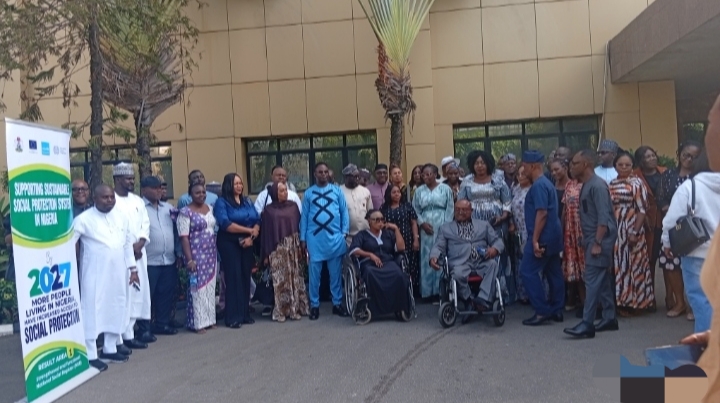
The training, organised under the Supporting Sustainable Social Protection Systems in Nigeria project, is funded by the European Union (EU) and jointly implemented by UNICEF and the ILO.
The programme is designed to strengthen the capacity of government officials and members of technical working groups to develop sound social protection policies, improve implementation strategies and expand the coverage of social protection programmes across the country.
Speaking at the opening of the training in Abuja on Monday, 23,November, 2026, the National Project Coordinator, Emmanuel Denjuma, who represented the ILO Country Director for Nigeria and ECOWAS, Vanessa Phala, said the ILO was responding to the country’s capacity-building needs in line with the project’s objectives.
Denjuma said the programme had brought together participants who are leading the project’s implementation to promote a common understanding of the need to strengthen social protection in Nigeria.
He explained that the central objective was to build a more effective and inclusive social protection system through improved policy design, stronger implementation and expanded access to interventions by citizens.
According to him, social protection remains a human right, making it imperative for government institutions to develop policies capable of ensuring that vulnerable populations are not excluded from essential social interventions.
He warned that poorly designed policies and weak implementation mechanisms could undermine the objectives of social protection programmes, leaving intended beneficiaries without the support they need.
Denjuma also identified the strengthening of the national social register as a critical component of efforts to improve the country’s social protection architecture.
He said a robust social register was essential for identifying vulnerable households and determining those eligible for government social interventions, stressing that expanding its coverage would improve the reach and effectiveness of social protection programmes.
READ ALSO:
- Rigging 2027 Election Could Lead To Civil War In Nigeria, Olawepo-Hashim Warns
- Boat Passengers Deserve Same Protection As Road, Air Travellers- Tinubu
- Nigeria Risks Security Setbacks Without Satellite Intelligence, AI – Experts
He said, “The goal for the training is to have a strengthened social protection system in the country, so that we can have better design, better implementation, and then increase coverage and access to social protection by citizens, because social protection is a human right.
If you don’t have good policies, if you don’t have well-designed policies, it therefore means that those who are supposed to benefit will not.”
“The need to train those policymakers and then implement that is very critical. That’s why they are trained, so that in the design and also the implementation will be robust enough.
“For us, the first resort area is how can we have a strengthened national social register. If we’re able to make sure that the social register is robust enough to capture more people, that is the first-level entry point or pathway for whoever will benefit from social intervention in the country.
The project is being implemented in four states, selected based on their different socioeconomic conditions, levels of poverty, vulnerability and social protection needs.
Denjuma said the interventions were also intended to generate lessons that could support broader improvements in Nigeria’s national social protection framework.
He noted that while the ILO and UNICEF were concentrating their interventions in the four selected states, the EU was supporting other social protection initiatives in additional parts of the country.
He expressed optimism that the training would equip policymakers with the necessary knowledge and skills to develop more responsive policies and strengthen the institutions responsible for delivering social protection programmes.

