

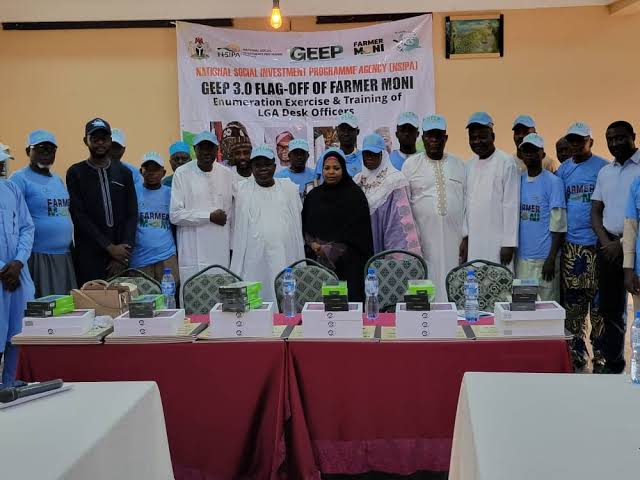
The Kwara State government on Thursday commenced the enumeration of farmers across the 16 local government areas of the state under the Federal Government’s Government Enterprise and Empowerment Programme (GEEP) 3.0 FarmerMoni initiative.
The government assured the prospective beneficiaries that participation in the exercise is free, warning officials against attempts to extort the applicants.
The exercise, organised by the National Social Investment Programme Agency (NSIPA) in collaboration with the state government, also featured the training of local government desk officers who would coordinate the enumeration and ensure that genuine smallholder farmers benefit from the interest-free loan scheme.
Speaking at the flag-off ceremony in Ilorin , the special adviser and focal person to the Kwara State Government on NSIPA, Dr Rabiat Jimoh Alabere, said the initiative was designed to improve farmers’ access to financial support, strengthen agricultural productivity and promote food security.
Alabere described the programme as an important intervention for smallholder farmers, noting that access to affordable financial assistance would enable them to expand their agricultural activities and improve their livelihoods.
She, however, stressed that the credibility of the enumeration exercise would determine the success of the programme, urging the local government desk officers to discharge their responsibilities with professionalism, transparency and accountability.
“Your role in this programme is very important. You are expected to handle this assignment with professionalism, transparency and a sense of responsibility.
“The success of this programme will depend largely on the credibility of the enumeration process, accurate documentation and proper engagement with the intended beneficiaries,” she said.
Alabere urged the officers to pay close attention to the training and ensure that the selection process was fair, accurate and free from discrimination.
She also called on community leaders, stakeholders and farmers across the state to cooperate with the enumerators to ensure that only qualified and genuine farmers were captured for the programme.
In her remarks, the North-Central Coordinator of GEEP, Hajia Hawa Abubakar, assured prospective beneficiaries that the enumeration exercise was entirely free, warning that nobody should demand money from farmers under the guise of facilitating their registration.
“I want to remind our desk officers that this exercise is completely free of charge,” Abubakar said, emphasising that no eligible beneficiary should be asked to pay to participate in the programme.
She urged residents, particularly small-scale farmers, to take advantage of the Federal Government’s intervention, which seeks to strengthen economic activities at the grassroots and improve access to financial opportunities.
READ ALSO:
- Security: Porous Borders, ECOWAS Protocol Fueling Farmer-Herder Clashes — Analyst
- BBC Launches Dars Hausa To Reach Nigerian Children Shut Out Of Classrooms
- Firefighters Avert Major Fire Disaster In Kwara As Petrol Tanker Catches Fire
Abubakar also cautioned the desk officers against practices capable of compromising the integrity of the exercise, insisting that the process must remain transparent and accessible to all qualified applicants.
She commended Governor AbdulRahman AbdulRazaq, who was represented by his adviser and counselor, Alhaji Saadu Salahu, for his administration’s collaboration with the Federal Government in implementing social investment programmes in Kwara State.
She equally commended the state NSIPA focal person and other stakeholders, for their support in facilitating the commencement of the exercise.
Other dignitaries at the event included the commissioner for Livestock Development, Hon. Oluwatoyosi Thomas; programme consultants and trainers; and the chairman of the All Farmers Association of Nigeria (AFAN) in the state, Malam Shuaib Ajibola.
Local government desk officers drawn from the 16 councils participated in the training ahead of the enumeration exercise.
The FarmerMoni initiative, under GEEP 3.0, is expected to expand financial inclusion among smallholder farmers, support agricultural activities and contribute to poverty reduction and food security across Kwara State. Kwara’s development aspirations must remain bigger than individual political disagreements or the changing fortunes of political associates.
Since assuming office, Governor AbdulRazaq’s administration has undertaken interventions across several critical sectors, including agriculture, infrastructure, education, healthcare and human capital development.
These efforts constitute part of the administration’s record and deserve to be assessed on their merits. Of course, no administration is beyond criticism, and there will always be areas requiring greater attention, improved delivery and further investment. That, however, is an argument for consolidation and improvement, not a reason to abandon the broader development agenda.
With the 2027 general elections drawing closer, the political environment will naturally become more active. Different interests will emerge, alliances may shift, and competing narratives will become more pronounced. The appropriate response should be one of strategic engagement, political maturity and a clear appreciation of the expectations of the electorate. There is also a compelling need to strengthen existing relationships, address genuine grievances and sustain constructive engagement with stakeholders across the state.
Those who choose to pursue different political paths are entitled to their choices. Their decisions, however, should not diminish the contributions of those who remain committed to the development of the state, nor should they erase the collective efforts that have gone into building the political and governance structures of the present administration. Political relationships may change, but the responsibility to the people remains.
Ultimately, the question before Kwara is not simply who has defected, who has withdrawn support or who has chosen a different political platform. The more important question is how the state can sustain its development trajectory, consolidate existing gains and create even greater opportunities for its people. That is the conversation worthy of public attention.
Kwara must keep moving forward. Political disagreements will come and go; alliances will be formed and dissolved. But the aspirations of the people must remain constant, and the pursuit of sustainable development must never take a back seat to transient political considerations.

