

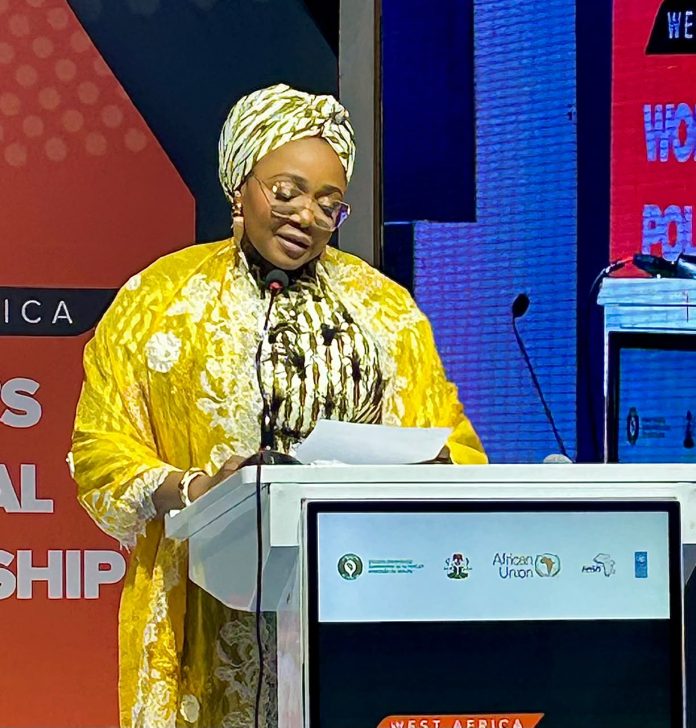
Minister of Women Affairs and Social Development, Imaan Sulaiman-Ibrahim, has called for far-reaching structural reforms to accelerate women’s political participation across West Africa, unveiling a five-point roadmap aimed at removing barriers to leadership.
The Minister made the call while speaking at the High-Level Women’s Political Leadership Forum convened by ECOWAS, the Nigerian Government, the African Union, the African Women Leaders Network (AWLN) and UNDP in Abuja.
Sulaiman-Ibrahim said women’s political leadership is no longer a matter of equity but national development and democratic effectiveness.
“Women’s political leadership is no longer a question of fairness to women. It’s a matter of competence on the part of nations for me. This is because a democracy that rules with only half of its talent is not only unjust. “It’s underperforming,” she said.
“Women make up more than half of the population of West Africa, but hold less than 20 per cent of parliamentary seats,” she said, stressing that the challenge is institutional, not a lack of capable women.
African women have no shortage of ability. “They have structures that were never meant to let them through,” she said.
Read Also: Tinubu Dissolves Federal Properties Alienation Committee, Orders Immediate Reforms
“Women lead 11 of the country’s 24 commercial banks, hold about one-third of superior court positions and make up more than 30 per cent of senior roles in the Federal Civil Service, but hold less than five per cent of elected offices in Nigeria,” the minister said.
When competence is the standard she rises Too many are held back where barriers to entry and structural barriers are in the way. The candidate isn’t our problem. “It’s the way,” Sulaiman-Ibrahim explained.
To plug this gap, she laid out a five-point road map to advance women’s political leadership across the ECOWAS region.
She proposed setting up a “Women’s Political Leadership Trust Fund” to help break down financial obstacles by providing assistance for nomination fees, campaign financing and leadership development for credible female candidates.
The minister also called for the current 35 per cent affirmative action benchmark to be made an enforceable commitment through political party compliance and electoral laws, learning from Rwanda and Senegal where reforms backed by law have increased women’s representation in Parliament.
Sulaiman-Ibrahim also called for the establishment of a “ECOWAS Women’s Leadership Compact” to enhance collaboration between women in elective and appointive positions and civil society organisations to translate advocacy into legislative and policy outcomes.
Sulaiman-Ibrahim urged women in the region to support qualified female candidates in elections, saying unity at the ballot box was a strategic tool to increase representation.
She suggested the creation of a “Regional Women’s Leadership Academy” to build a pipeline of future leaders by identifying, mentoring and grooming women from ward and local government levels for elective offices.
The minister said Nigeria is already doing something on this through the review of the National Gender Policy, implementation of the Third National Action Plan on Women, Peace and Security across 16 states and expansion of the Nigeria for Women Programme which targets more than five million beneficiaries to strengthen economic empowerment.
Sulaiman-Ibrahim also highlighted the “Power of 10 Million” movement, through which women from all 774 local government areas and 8,809 wards in Nigeria have mobilised and presented a Nigeria Women’s Charter for National Development.
She called on governments and development partners to move beyond dialogue and institutionalize reforms that will deliver measurable progress.
“History is not made by those getting together to talk about change. It is made by those who have the courage to make it institutionalised,” she said.

