

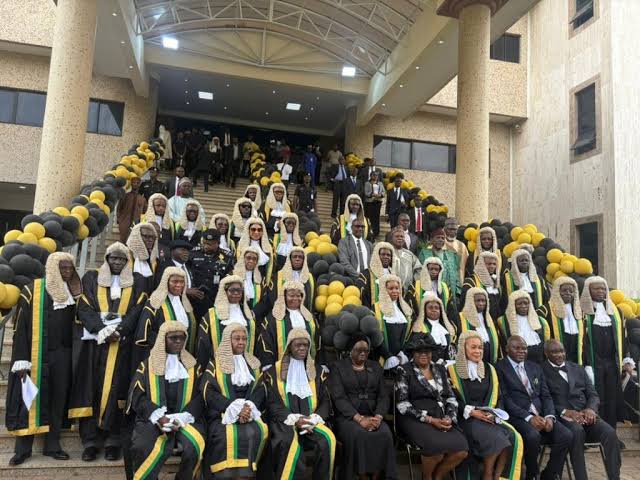
With concerns mounting over the credibility of the 2027 general elections, the Nigerian Bar Association (NBA) President, Mrs Oyinkansola Badejo-Okusanya (SAN) and other judicial stakeholders have warned that electoral violence, political interference and excessive reliance on litigation could weaken public confidence in Nigeria’s democratic institutions.
The stakeholders, who spoke on Thursday at the 2026 Conference of the National Association of Judiciary Correspondents (NAJUC), Abuja Chapter, called for greater accountability among political actors, respect for the rule of law and reforms to strengthen public confidence in the judiciary.
At the conference, themed “Deepening Nigeria’s Electoral Integrity: The Ballot versus The Verdict”, they stressed that the credibility of elections must be established at polling units rather than through post-election litigation.
They warned that political violence, internal party disputes and excessive reliance on judicial intervention could undermine democratic institutions.
Badejo-Okusanya, who was represented by the NBA National Publicity Secretary, Dr Prince Azubuike, described the media as an indispensable institution in promoting public understanding of the justice system, particularly the relationship between electoral processes, judicial intervention and public trust in democratic institutions.
The NBA president said the ballot represented the sovereign right of Nigerians to freely elect their leaders, while the courts provided the constitutional mechanism for resolving disputes arising from the electoral process.
She maintained that electoral credibility depended not only on free, fair and transparent elections but also on the integrity of the judicial processes through which disputes were determined.
Badejo-Okusanya further emphasised that the judiciary must remain independent and impartial, with decisions grounded in law, supported by sound reasoning and delivered without fear or favour.
She also urged political actors and electoral institutions to demonstrate genuine commitment to democratic principles and the rule of law.
The NBA president noted that judiciary correspondents had a special responsibility to report proceedings and judgments accurately, fairly and professionally, particularly in politically sensitive election disputes.
In his remarks, the Senior Special Assistant on Media to the Chief Justice of Nigeria (CJN), Mr Tobi Soniyi, acknowledged that the Nigerian judiciary and the Independent National Electoral Commission (INEC) faced significant institutional challenges but cautioned against judging public institutions without understanding the circumstances within which they operated.
Drawing from his experience as a political and judicial editor before joining the judiciary, he said his perspective had changed after gaining closer insight into the challenges confronting judges.
He explained that journalists sometimes criticised institutions from the strength of their own positions without adequately understanding the difficulties faced by those being criticised.
However, he insisted that acknowledging institutional challenges should not prevent stakeholders from demanding improvements, accountability and better service delivery.
READ ALSO:
- Lagos Court Hears Contempt Case Against Jimmy Odukoya
- Coalition Warns Politicians Against 2027 Election Violence
- Kaduna Govt, CSOs Mobilise Against Violence As 16 Days Of Activism Begins
He cited instances where litigants travelled from other cities to attend court proceedings only to discover that the presiding judge would not sit, describing such experiences as unacceptable and a source of hardship for citizens seeking justice.
Soniyi questioned why litigants should face sanctions for failing to comply with court procedures while there appeared to be insufficient consequences when judges failed to sit without adequate consideration for those who had travelled to court.
The CJN’s media aide blamed politicians for frequently dragging their internal disputes before the courts, even when such disagreements arose from their failure to obey their own party constitutions and internal regulations.
He said political parties should learn to resolve internal disagreements through established mechanisms instead of expecting the judiciary to settle every dispute.
He warned that politicians must not create problems within their parties and subsequently blame the courts for the consequences.
He also urged judges to be more cautious about entertaining disputes that political parties ought to resolve internally, saying courts should, where appropriate, compel political actors to take responsibility for their actions.
According to him, excessive political litigation places unnecessary pressure on the judiciary, consumes judicial time and delays the determination of other important matters, including criminal cases and human rights violations.
Earlier in his welcome address, the Chairman of NAJUC, Abuja Chapter, Mr Olakunle Olasanmi, warned that Nigeria’s electoral process was increasingly threatened by violence, intimidation and the growing perception that electoral victories were determined more by court judgments than by votes cast at polling units.
He said although the country had recorded improvements in voter registration technology, biometric verification and transparency in the transmission of results, persistent challenges such as logistical failures, voter intimidation, violence and delayed results continued to undermine public confidence.
Olasanmi warned that allowing politicians who allegedly perpetrated electoral violence and manipulated the process to secure favourable judgments could encourage the continuation of such practices, particularly where perpetrators believed they could ultimately retain political power through litigation.
He said: “The danger in allowing the courts to decide who gets what in our election is that a candidate will perpetuate violence, rig elections, get into office, cover up evidence and have his election affirmed by the courts.
“As long as these politicians continue to get favourable judgments from the courts, the trend will not cease.
“The courts are good and are there to resolve disputes but in an election, it is better the people are given the opportunity to choose and decide who governs them, not the court.
“But for the courts today, a greater number of public officials occupying elective positions will not be there.”

