

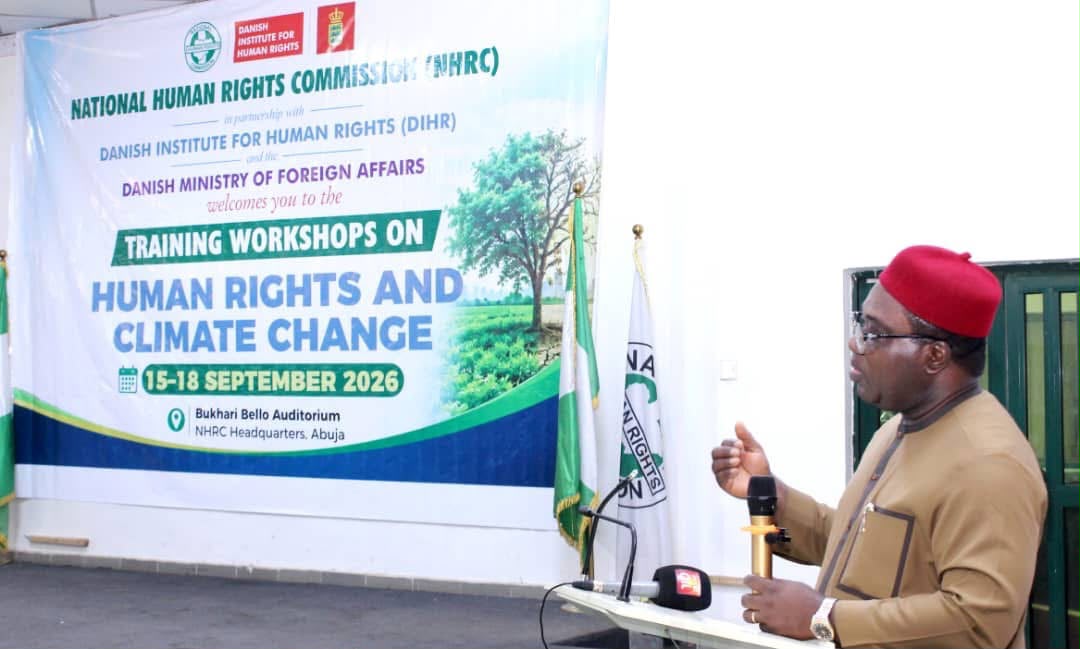
The National Human Rights Commission (NHRC) has called for human rights to be mainstreamed into Nigeria’s climate change policies and government responses, warning that environmental changes are increasingly threatening people’s rights to life.
The Executive Secretary of the commission, Tony Ojukwu, made the call during a climate change and human rights training organised by NHRC in collaboration with the Danish Institute of Human Rights (DIHR), stressing that climate change was not only an environmental concern but also a growing human rights challenge.
Ojukwu said human activities contributing to greenhouse gas emissions were affecting the climate, with consequences already being felt through increased flooding, extreme temperatures and changing farming seasons.
“When we talk about climate change, we’re looking at the human rights impacts and the effects on people’s rights,” he said.
READ ALSO: NHRC Boss Receives International Humanitarian Award
The NHRC chief explained that flooding could destroy homes and property, expose communities to waterborne diseases and cause injuries or deaths, while extreme heat could increase health risks and place additional pressure on healthcare systems.
He said changing climatic conditions could also threaten livelihoods, businesses and food security, making it necessary for the government to consider the broader human rights implications of climate policies and interventions.
Ojukwu said the NHRC was preparing its personnel to respond to an expected increase in complaints arising from climate-related human rights violations.
“We need to mainstream human rights into the government’s response to climate change,” he said, urging authorities to involve the commission and human rights experts in climate change planning.
He called for a comprehensive review of Nigeria’s national climate change policy to ensure that human rights considerations were incorporated into its implementation.
“If that is not done, there is going to be a gap,” Ojukwu said, adding that government efforts could fail to fully address the impact of climate change on people’s lives if human rights were excluded.
The chief adviser at the Danish Institute for Human Rights, Maria Poppins, said climate change was already undermining development gains and the fulfilment of economic, social and cultural rights.
Poppins said it was particularly concerning that countries and communities that had contributed least to the global climate crisis were often among those suffering its most severe consequences.
She said national human rights institutions could play a critical role by collecting data, documenting evidence, conducting awareness campaigns, handling complaints and advocating policies that protect vulnerable communities.
Poppins also said such institutions could use their mandates to influence climate laws, policies and initiatives aimed at improving rights protection for people whose lives and livelihoods were being negatively affected by climate change.
She expressed hope that the training would strengthen the NHRC’s capacity to address climate-related human rights challenges in Nigeria through advocacy, evidence-based interventions and engagement with affected communities.
The workshop aimed to strengthen the commission’s understanding of, and institutional response to, the growing intersection between climate change and human rights.

