

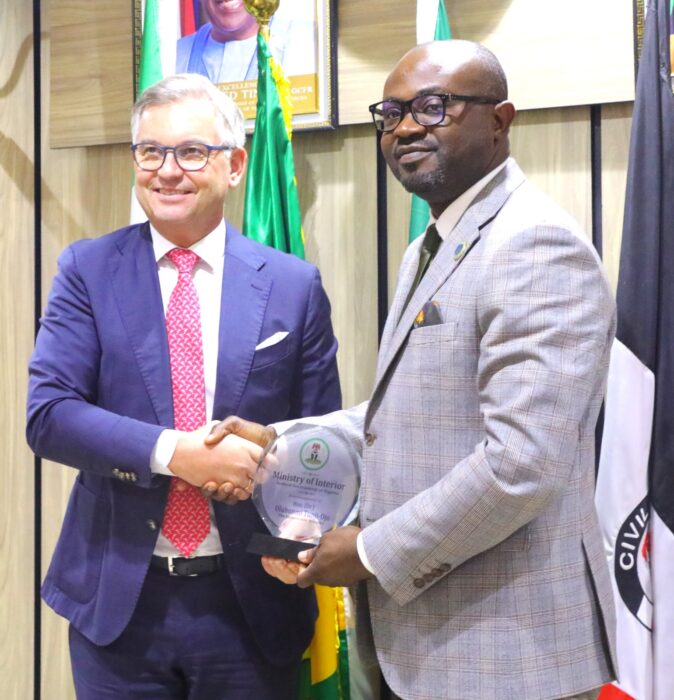
Nigeria and the European Union (EU) have concluded negotiations on a long-awaited readmission agreement aimed at facilitating the return of Nigerians with no legal grounds to remain in EU member states, marking a major milestone in migration cooperation between both sides after nearly a decade of negotiations.
The development was contained in a statement electronically signed by the head of press and public relations, Ministry of Interior, Mrs Mary Ali.
According to the statement, the agreement, which is expected to be formally signed following its finalisation, will strengthen cooperation in border security, identity verification and the fight against human trafficking and migrant smuggling.
The statement disclosed that the Minister of Interior, Dr Olubunmi Tunji-Ojo, made this known on Tuesday during a meeting with the EU Commissioner for Internal Affairs and Migration, Magnus Brunner, and his delegation at the Ministry of Interior.
Describing the agreement as a significant step in Nigeria-EU relations, Tunji-Ojo reportedly reaffirmed the Federal Government’s commitment to honouring its provisions, stressing that Nigeria would not encourage irregular migration or tolerate any abuse of the trust between partner countries.
According to the statement, the minister emphasised that the agreement was not solely about returning Nigerians from Europe but also about establishing a more orderly, dignified and mutually beneficial migration management framework.
The statement further noted that a major component of Nigeria’s strategy was the modernisation of its migration and border management infrastructure through automation and the integration of national identity databases.
Tunji-Ojo, according to the statement, revealed that the Federal Government had migrated more than 17 million migration records into an integrated system designed to make the identification and verification of returning Nigerians faster and more reliable.
He explained that the system would enable authorities to establish the nationality of Nigerians across three categories: those with valid Nigerian travel documents, those who travelled with documents but subsequently lost or destroyed them, and those who travelled without any form of identification.
The minister said the government was developing mechanisms to verify the identities of individuals in all three categories through available national records.
The statement also quoted him as saying that the federal government was already implementing similar arrangements with the United Kingdom, while discussions were ongoing with the United States to replicate the system.
READ ALSO:
- Yobe PCC Resolves 560 Complaints In 1 Year, Reviews 337 Others
- No New Ebola Case In Nigeria As 28 Contacts Remain Under Monitoring – NCDC
- CHOGM: Nigeria Calls for Stronger Commonwealth Response to Global Challenges
On broader security concerns, Tunji-Ojo called for stronger international collaboration and real-time intelligence sharing to combat human trafficking, migrant smuggling and other transnational crimes.
He maintained that such challenges could not be effectively addressed without coordinated efforts among countries, adding that improved trust and cooperation would create better opportunities for legal migration.
The statement further disclosed that the Federal Government had recorded significant progress in correctional service reforms, with the number of repeat offenders reportedly dropping from approximately 13,000 in 2023 to about 1,600 in 2025.
In his remarks, EU Commissioner Brunner described the conclusion of the negotiations as an important development that could open new areas of cooperation between Nigeria and the European bloc.
He commended federal government efforts to modernise its border security architecture and expressed the EU’s readiness to strengthen collaboration through its border management agency.
According to the statement, Brunner identified police cooperation, the fight against human trafficking and migrant smuggling, and the expansion of legal migration pathways as priority areas for deeper engagement.
He also disclosed that approximately 260,000 Nigerians were legally resident in EU member states, emphasising the need to create more opportunities for safe and regular migration.
Also speaking, a member of the delegation, Johannes Lucher, acknowledged the difficulties encountered during the negotiations, explaining that Nigeria had pushed for broader cooperation beyond the readmission arrangement.
Lucher reportedly said Nigeria had sought to incorporate issues such as anti-trafficking measures, the fight against drug trafficking and legal migration pathways into the agreement.
He assured that discussions on these additional areas would commence following the conclusion of the readmission deal.
The statement further quoted him as disclosing that “the EU had made available nearly €100 million in additional funding to support broader cooperation, with discussions expected to begin with relevant Nigerian migration and security officials.
“The conclusion of the negotiations represents a significant development in Nigeria’s engagement with the EU on migration governance, although the effectiveness of the arrangement will ultimately depend on its implementation, respect for the rights and dignity of returnees, and the expansion of legitimate migration opportunities.”
Both parties reaffirmed their commitment to strengthening mutual trust, deepening bilateral cooperation and developing practical solutions to shared migration and security challenges.

