

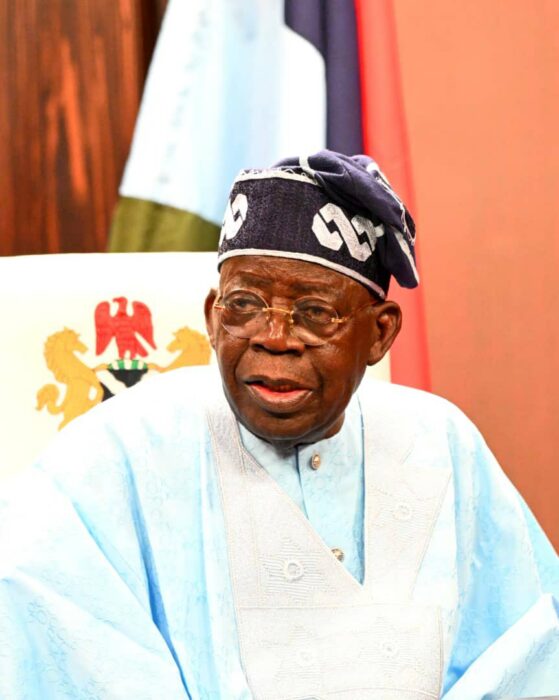
President Bola Tinubu has said non-oil activities now account for about 96 per cent of Nigeria’s Gross Domestic Product (GDP), while the country’s non-oil exports have crossed $6bn, the highest level in its history.
The President also disclosed that Nigeria’s external reserves had risen to about $55bn, representing more than 14 months of import cover.
Tinubu made the disclosures on Thursday in Abuja at the public presentation of the book, Economic Diversification and Structural Transformation in Nigeria: Past, Present and Future, authored by the member representing Kiru/Bebeji Federal Constituency of Kano State, Abdulmumin Jibrin Kofa.
The President, who was represented at the event by the Speaker of the House of Representatives, Tajudeen Abbas, said the figures reflected progress in the government’s efforts to move the economy away from its historical dependence on crude oil.
He noted that Nigeria had for decades depended heavily on oil revenues, leaving its budget, currency and livelihoods vulnerable to fluctuations in the international oil market.
According to him, the administration inherited a difficult economic situation marked by a weakening naira, high debt-service obligations, depleted foreign reserves, fuel subsidy costs and declining industrial activities.
Tinubu said his administration chose difficult but necessary reforms, including the removal of fuel subsidy and unification of the foreign exchange market, to address the country’s economic challenges.
“We chose reform over ruin. We removed the fuel subsidy. We unified the exchange rate. These were not easy decisions, and I know the weight they placed on every household. But they were necessary, and today the pain is yielding its promise,” he said.
The President said Nigeria’s economic priorities had shifted from stabilisation to shared prosperity, with the government targeting a $1tn economy by 2030 under the Medium-Term National Development Plan 2026–2030.
He disclosed that non-oil revenue grew from N13.63tn in 2023 to N16.4tn in the first half of 2026.
Tinubu, however, stressed that government alone could not achieve the ambitious economic target, noting that private enterprises would play a critical role through investment, innovation, manufacturing and exports.
He said the government expected the private sector to provide 86 per cent of the investment required to achieve the 2030 economic target.
The President explained that the 2025 budget introduced a De-risking Framework to attract private capital, while the ongoing tax reforms were designed to harmonise the country’s tax system and eliminate multiple taxation.
“We cannot tax our way into prosperity; we must produce our way there,” he said.
On infrastructure, Tinubu said his administration was investing in power, roads and railways to support industrialisation, agricultural production and trade.
READ ALSO:
- Tinubu Calls on Nigerian Youths to Reject Division and Embrace Unity
- Ododo Charges RTIFN Executives On Tinubu’s Grassroots Mobilisation
- 2027: Sokoto Students Unveil Campus Ambassadors For Tinubu, Aliyu
He disclosed that Nigeria had won a $3.38bn arbitration at the International Chamber of Commerce in Paris over the Mambilla hydropower project, freeing the project from a dispute that had stalled it for more than nine years.
He also said Geregu Power was working to increase its generating capacity to 1,300 megawatts, while the Port Harcourt and Warri refineries were gradually resuming operations.
On transportation infrastructure, the President listed the Kano-Katsina-Maradi railway, Lagos-Calabar Coastal Highway and Sokoto-Badagry Superhighway among projects expected to improve trade and economic activities across the country.
He added that road projects were ongoing across the six geopolitical zones to ensure equitable distribution of infrastructure.
Tinubu also outlined the administration’s plans to strengthen agriculture through irrigation, mechanisation and livestock reforms, while supporting local manufacturers with single-digit interest loans.
He said the government was determined to ensure that Nigeria’s solid minerals were processed locally rather than exported in their raw form.
The President further highlighted investments in digital infrastructure, including plans to lay 90,000 kilometres of fibre-optic cables and the 3 Million Technical Talent (3MTT) programme aimed at equipping young Nigerians with digital skills.
He said the Bank of Industry was also extending low-interest loans and grants to market women, artisans and young entrepreneurs across the 774 local government areas.
On housing, Tinubu disclosed that more than 10,000 homes were under development across 14 states and the Federal Capital Territory under the Renewed Hope Cities and Estates Programme.
He added that the MOFI Real Estate Investment Fund had facilitated about N128bn in mortgages for 1,859 families across 25 states at a fixed interest rate of 9.75 per cent over 20 years.
The President also announced plans to work with the National Assembly and relevant stakeholders to establish a regulatory authority for the housing and real estate sector to strengthen transparency, set standards and provide avenues for consumer redress.
Tinubu commended Jibrin for the book, describing it as a reflection of the country’s economic journey and the challenges and opportunities ahead.
He said the author’s experience as a lawmaker and former chairman of key National Assembly committees, particularly Finance and Appropriations, had given the publication the benefit of practical legislative and economic experience.
The President urged Nigerians, including government officials, entrepreneurs, farmers, academics and young people, to work together towards building a prosperous economy.
“An age of prosperity is not a gift that falls from the sky; it is a house we must build together: government and enterprise, scholar and farmer, the young and the seasoned,” he said.

