

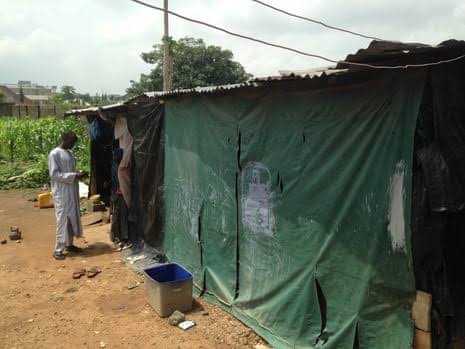
Poverty will continue to fester in Nigeria unless development is centred on the people, a Professor of Development and Applied Economics has warned, accusing successive governments of imposing white-elephant projects on Nigerians while the poor pay the price of failed development.
Professor Joseph Momba Ibi gave the warning while delivering the 64th Professorial Inaugural Lecture of Nasarawa State University, Keffi (NSUK).
The lecture, titled “From Plans to People: Policies, Projects, and the Nigerian Quest for Shared Prosperity,” was the eighth in the 2026 inaugural lecture series and the first from the Department of Economics.
The Vice-Chancellor, Professor Sa’adatu Hassan Liman, who was represented by Professor Mohammed Ari, presided over the ceremony.
Development Must Be Measured By Impact On People.
In his remarks, Prof. Ari said an inaugural lecture is one of the highest traditions of the university, where a professor presents the essence of his life’s work to the university community and the wider society.
He noted that Nigeria has had development plans, visions, agendas and reforms since independence, but the critical question remains the extent to which they have translated into better lives for the people.
“Development should not be measured by the beauty of policy documents or the number of projects commissioned, but by its impact on human life,” he said.
“True prosperity is shared prosperity. Prosperity that reaches the farmer, the trader, the student, the youth, and the vulnerable.”
Also speaking, the Dean, Faculty of Social Sciences, Professor Yahaya Abdullahi Adadu, said the lecture was the third this year from the Faculty and the ninth from the Faculty overall.
He said Prof. Ibi joined the Faculty in 2006 and has served as a member of the Faculty Board, a member of several committees, and Chairman of the Faculty Conference Committee, for which he produced a report and published conference proceedings.
Nigeria’s Problem Is Not Lack Of Plans
In his lecture, Prof. Ibi said Nigeria’s development challenge is not the absence of plans, policies or projects, but the lack of shared prosperity — development that transforms, influences and positively affects the lives of the people.
To bridge the gap between government plans and real impact, he proposed a new framework, the PPPP Model, also called the Four P Development Model — Plans, Policies, Projects, and People.
READ ALSO:
- INEC Postpones Voters’ Register Clean-Up Until After 2027 Elections
- How Buhari’s Leadership, Policies Shaped Nigeria’s Development — Ex-Minister Sambo
- Edo’s Development Depends On Tinubu’s Re-Election, Says Okpebholo
He described the model as workable, empirical and functional, with both conceptual clarification and mathematical connotations.
He said his next challenge is to test the model empirically in policies to prove its effect, insisting that if applied, it will work.
Projects Must Reflect People’s Priorities
Prof. Ibi recommended that government projects must be based on priorities.
He explained that priority means what the community, the people, or the state actually need, not what the government wishes to do. Projects not based on the real priorities of the community amount to mere government rhetoric.
Citing the establishment of a school as an example, he said it would amount to mere rhetoric if it does not include a plan to mop up out-of-school children who dropped out because they cannot afford fees.
He said the bottom 40 per cent of the population bear the brunt — their children drop out, cannot afford school fees, and even after struggling to finish, are often locked out of employment.
“So, if anything I’m doing, it must capture this essence: the people are the heart, at the centre of that,” he said.
Stop The Top-Down Approach
The don also slammed the top-down approach to governance, where leaders decide projects for communities without asking them what they need, and urged government to adopt a bottom-up, inclusive approach where the people decide what they want.
“Better to come and say, ‘We will build airport’ when they don’t need the airport. That’s a top-down approach, deciding on what you should do and doing it for the people whether they like it or not. But the bottom-up approach is an inclusive approach that involves people decide what they want,” he said.
The lecture was attended by principal officers, deans, professors, lecturers, students, and invited guests.

