

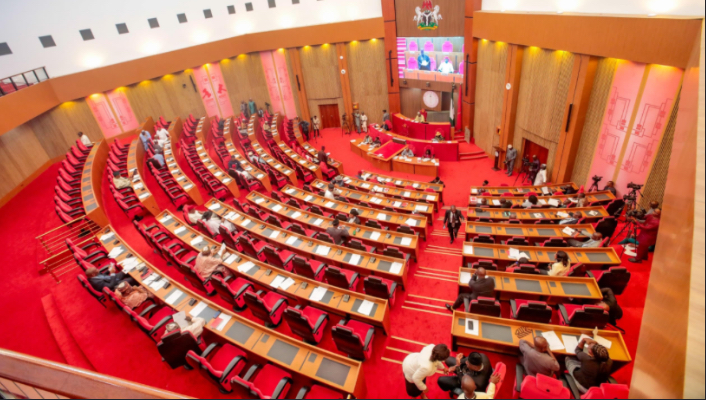
The Senate on Tuesday ordered an investigation into the frequent, prolonged closures of Nigeria’s airspace during Very Important Person (VIP) movements, warning that poor coordination among aviation authorities could endanger lives and disrupt commercial flights.
Lawmakers also expressed concern that passengers and aircraft were facing unnecessary delays, with some planes reportedly forced to remain airborne for extended periods while awaiting clearance.
The resolution followed a motion sponsored by Senator Isah Jibrin during plenary, which highlighted operational lapses surrounding airspace restrictions and their implications for aviation safety, passenger welfare and the economy.
Consequently, the Senate mandated its Committee on Aviation, chaired by Senator Abdulfatai Buhari, to investigate the circumstances surrounding the restrictions and determine whether aviation authorities were complying with established operational procedures.
The committee was directed to liaise with the Nigerian Civil Aviation Authority (NCAA), Nigerian Airspace Management Agency (NAMA), Nigerian Safety Investigation Bureau (NSIB) and Federal Airports Authority of Nigeria (FAAN), and to report its findings within two weeks.
The Senate also urged relevant aviation agencies to consider diverting commercial flights to alternative airports whenever airspace restrictions are imposed, rather than allowing aircraft to hover for extended periods while awaiting clearance.
Contributing to the debate, Senator Diket Plang, who represents Plateau Central, blamed poor coordination of flight schedules for some of the avoidable delays.
Plang, who recalled his experience as a station manager with Kabo Air in Kano in 1996, said aviation authorities should coordinate take-off and landing schedules properly, particularly when VIP movements are expected.
He argued that commercial aircraft should not be cleared for destinations where authorities already know that airspace restrictions will be imposed.
“It would be very wrong for any instance that a VVIP is flying and landing in a particular area, and you know the timing, because all flights are a function of time. And you still allow another aircraft to leave another airport to the same destination that a VVIP is landing. For me, it is mismanagement of time,” he said.
The senator also raised concerns about compliance with aviation safety regulations, particularly requirements relating to adequate fuel reserves for emergencies and possible diversions.
“If we don’t manage space, it can lead to calamity,” he warned.
Plang described the motion as an opportunity to address systemic weaknesses in the aviation sector and called on the NCAA and FAAN to take decisive action to prevent further disruptions.
He cautioned that aircraft in flight could not simply stop or find a parking space when unexpected restrictions or emergencies occurred.
“An aircraft is called a flying coffin. Once it is in the air, it is considered to be a flying coffin. And therefore, there is no parking space in the air for you to do any repair,” he said.
Also supporting the motion, Senator Abdul Ningi, representing Bauchi Central, described the situation as an emergency requiring urgent intervention by the National Assembly.
He lamented that prolonged flight delays had become commonplace, blaming weak supervision and the failure of aviation regulatory agencies to enforce operational standards.
“Mr. President, we are operating as if we are a lawless country. No one of us here, no one who applies, has not had the same experience,” he said.
Ningi argued that responsibility for addressing the problem rested not only with the aviation agencies but also with the National Assembly, which oversees their operations.
“And the onus is not on NCAA or NAMA. The onus is on the National Assembly that supervises them to do the needful,” he added.
Recounting a recent experience, the senator said a journey from Kano that should have taken about 40 minutes took two and a half hours because of airspace-related delays.
“Last week, I was coming from Kano. A flight that should have taken just 40 minutes took two and a half hours because of this attitude. And when we landed, people were abusing the government; people were abusing the Senate,” he said.
READ ALSO:
- “Your Action Is a Disgrace to the Senate” — OK Movement Blasts Natasha
- Tinubu Requests Senate’s Approval to Borrow Additional $7.7bn Abroad
- Air Peace Offloads Passenger Over Threat to Set Abuja-Bound Aircraft Ablaze
He also accused airlines and regulatory authorities of failing to provide passengers with adequate explanations when flights were delayed for several hours.
“You go to the airport, your flight is delayed for several hours. And nobody will say anything about it,” he lamented.
Senate President Godswill Akpabio, while contributing to the debate, recalled an experience in which passengers were kept inside a bus for about three hours while waiting to board an aircraft, despite his position at the time as a state governor.
He said the experience exposed poor coordination surrounding VIP movements and the restrictions imposed on commercial flights.
According to him, aviation authorities sometimes close airspace long before the VIP arrives at the airport, leaving commercial aircraft circling and passengers stranded on the ground.
Akpabio explained that restrictions could begin even before the President left his location for the airport.
“So even when the President has not come down from upstairs, they have already closed the airspace. So that would take another one hour,” he said.
He added that the situation could worsen if the President was still travelling to the airport or attending engagements before departure.
“So by the time the President is leaving and is on the road, the airspace has been closed for two hours. By the time he finishes his pleasantries at the airport and is about to travel, the airspace remains closed. And planes are overflying, turning and turning and turning,” he said.
The Senate President criticised the practice, arguing that airspace restrictions should be properly synchronised with VIP movements to minimise disruptions to commercial aviation.
He suggested that authorities should wait until the President was on the way to the airport before activating the necessary restrictions, rather than shutting down the airspace hours ahead of the movement.
“They ought to know that they should turn; they should wait till the President is inside the car on the way to the airport at least before they can clear the air. But they will not do that,” he said.
Akpabio also raised concerns about the safety implications of prolonged holding patterns, particularly when aircraft had to remain airborne while awaiting clearance.
He disclosed that he had been informed that a recent aircraft crash in Nigeria might have been caused by fuel exhaustion while the aircraft was hovering in the air awaiting clearance.
However, he was quick to clarify that he had not received the official investigation report and could not independently confirm the circumstances surrounding the incident.
The Senate President subsequently directed the Committee on Aviation to convene an urgent meeting with the relevant agencies to establish the facts and recommend measures to prevent a recurrence.
He described the matter as potentially life-threatening and called for a comprehensive examination of the procedures governing VIP airspace restrictions.
Akpabio also asked the committee to establish whether similar airspace closures were extended to other categories of VIPs apart from the President.
He urged the aviation authorities to explain the basis for the restrictions, their duration and the operational guidelines guiding their implementation.
The Senate’s intervention underscores growing concerns over the balance between security arrangements for high-profile government officials and the safety, convenience and economic interests of ordinary air travellers.
The lawmakers maintained that while necessary security measures must be respected, they should not result in avoidable risks to aircraft and passengers or undermine the efficiency of the country’s aviation system.

