

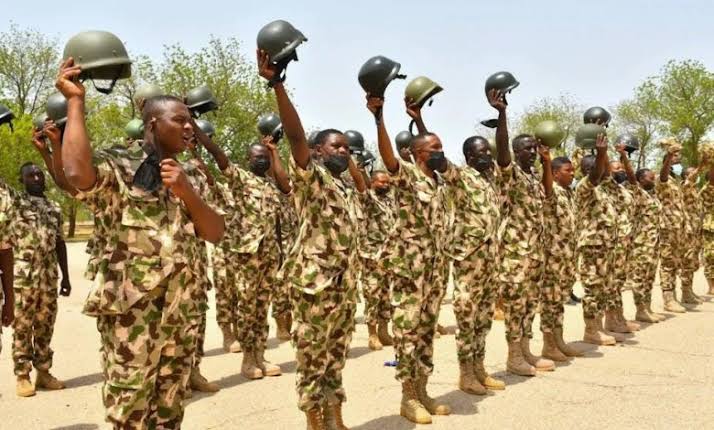
The Chief of Army Staff, COAS, Lieutenant General Waidi Shaibu, last month, expressed concern over the persistently low enlistment of youths from the Southeast geopolitical zone into the Nigerian Army.
Shaibu disclosed this during the passing-out parade of the pioneer batch of 90 regular recruits at the Nigerian Army Recruit Training Depot, Amasiri-Edda, Ebonyi State.
“Reports have it that the Nigerian government is begging the Southeast to fill its slots, while youths in other parts of the country are fiercely competing for the limited slots in the Army.
Shaibu said the South-East’s share of recruitment had remained unfilled for years, calling the trend unacceptable.
The Army Chief, however, called on traditional rulers, parents, community leaders and other stakeholders in the region to encourage eligible young men and women to take advantage of the recruitment opportunities available in the Nigerian Army.
He says military service is not just a career but an honorable calling that represents patriotism, leadership and national service.
He said: “We seek your continued support because military service is very demanding. Please support them, encourage them and pray for them.
“To our hosts the Ndigbo, I humbly beg you to encourage your youths to take their rightful place in the defense of our fatherland.
“Recruitment quota allocated to this zone has not been fully utilized for some time now. This must not go on. Military service is not just a career but an honorable pursuit of patriotism, leadership, and national contribution.
Therefore, I urge all leaders of communities, parents, guardians and elders across the Southeast to encourage our young men and women to see this depot as theirs and come out to serve the nation.”
No one wants to come in – Orji Kalu
Former Abia State Governor, Senator Orji Uzor Kalu had also expressed worries about the reluctance of a lot of people from the Southeast to join the security agencies in the country.
Kalu said this while commenting on the state of the nation in a recent interview with News Central TV.
The Abia Senator said that in his area, people were often given application forms to join the Nigerian Army, Police and Air Force, but many were still unwilling to apply.
“I know in my area they give me forms for people to join the Army; nobody wants to join. They give me forms for people to join the Police; nobody wants to join them. They will not want to apply. They give me forms for people to join the Air Force,” Kalu said.
He said Nigeria’s security issues are connected to issues of hatred, tribalism and religious divisions among citizens.
Kalu said Nigerians, especially in the Southeast, should see themselves as citizens of one country first and then work together to address insecurity.
He equally described the armed forces as some of the best institutions in Nigeria, saying that most of the personnel are not affected by tribalism.
Joe Igbokwe: Southeast will regret rejecting Army recruitment
Similarly, an All Progressives Congress, APC, chieftain, Joe Igbokwe, cautioned that the Southeast could face serious consequences in the future if young people in the region continued to show little interest in joining the Nigerian Army.
Reacting to reports that many recruitment slots allocated to the Southeast are yet to be filled as applicants from the North continue to fill their quotas in their large numbers, Igbokwe described the situation as worrying.
“South-East will regret rejecting Nigerian Army recruitment, mark my words,” he said.
Igbos face systematic marginalization – Lawyer, Ejimakor
However, human rights lawyer, Aloy Ejimakor stated that the unwillingness of Igbo youths to join the Nigerian armed forces is not due to a lack of valor but a deliberate refusal to serve an institution they distrust profoundly.
This was contained in a post by the lawyer on X after the Chief of Army Staff expressed concern over the persistently low enlistment of youths from the Southeast geopolitical zone into the Nigerian Army.
Ejimakor said that history and present events indicate that the Igbo people are systematically marginalized in an ethnically lopsided leadership structure in Nigeria’s security services.
“The armed forces are also weaponized against Ndigbo again and again in times of crisis,” the lawyer said.
“The trauma of the 1967 army massacres of Ndigbo in the North remains an unhealed wound, constantly reopened by modern atrocities targeting youths suspected of IPOB ties, such as the state-sanctioned violence at Nkpor, the Aba prayer ground, Obigbo, the Trump victory rally in Port Harcourt, and many others,” he stated.
He also said the youths are very angry over the inclusion of “repentant” Boko Haram terrorists into the military.
“They will not compromise their dignity by being asked to bleed under a biased command, with former terrorists.
“So their refusal to enlist is not cowardice. Rather, it is a silent, potent protest against an institution that has often betrayed the Ndigbo,” Ejimakor said.
Why SE youth don’t want to join Army
As reports say the Nigerian Army is finding it difficult to attract enough applicants from the Southeast for its recruitment exercise, spoke to some young South-easterners on why many youths in the region are reluctant to enlist.
Their answers varied between concerns over insecurity and bad welfare for soldiers to alleged discrimination, political interference and a general loss of confidence in the military.
‘I don’t want to die for politicians’
A trader from Anambra State, Chinedu Udemmezue told our correspondent on the telephone on Tuesday that he had nothing against the Nigerian Army.
He said that he once wanted to join the military but changed his mind due to concerns over the safety of soldiers.
“I don’t have anything against the Nigerian army,” he said. Actually, I wanted to join when I was younger. But today I am not interested anymore.
My fear is simple: I don’t want to go into the Army and be a casualty of a war politicians aren’t serious about ending. Look at the number of soldiers getting killed across different parts of the country.
“Sometimes you hear about soldiers being sent somewhere without the right equipment or support. Then, when something happens, they will talk about sacrifices.
“Sacrifice is good, but there has to be some reason to believe your life is valued. I have a family, I have a life. I cannot just volunteer to die because some people in Abuja want to score some political points.”
‘There’s a trust issue’
Enugu State graduate, Ifeanyi Nwankwo, said the major issue for him is trust.
Young people may be reluctant to join an organization where they believe opportunities and promotions are not always based on merit, he said.
“You cannot ask young people to join an organization when they think that opportunities and promotions are not always based on merit.
“For years there has been a perception that people from the Southeast are not treated fairly in some national institutions.
“It’s another question whether every allegation is true or not. But perception counts. If a young man thinks that even after joining the Army, he may not have equal opportunities because of where he comes from, why would he be in a hurry to join?
The government needs to deal with that perception. “You can’t just announce recruitment and expect people to forget everything they have heard or experienced,” he said.
‘Army not the problem
Chukwuebuka Eze, an undergraduate at Enugu State University of Science and Technology, said he actually wants to go into the Army but his parents are against it.
Their major concern was rising insecurity across the country, he said.
“I really want to join the Army. I have respect for the military, always have. But my parents are against it because of insecurity.
They keep asking me: ‘What will you get if you are killed?’ “That question is hard to answer,” he said.
“Why should I join when soldiers are badly treated?
A 27-year-old mechanic from Imo State, Uche Madu, said he had thought of joining the Army after his secondary school education, but changed his mind.
He said one reason was poor welfare for soldiers.
“Go and ask the families of soldiers who died on duty if they were properly taken care of. Sometimes it seems as if the government only remembers the soldiers when they have to send them into trouble.
‘If the salary, insurance, housing, healthcare and welfare are attractive, you will see more young people applying.
“Why would I choose the military if I can work here as a mechanic, run a business or travel abroad and potentially earn better money without carrying a gun into a dangerous place?” he asked.
‘Don’t politicize the military’
Obinna Onwe, 29, a civil servant from Ebonyi State, said one of the major factors discouraging young people from joining the military was alleged political interference.
“The biggest problem for me is political interference.
“The military should be a professional institution serving the country, not politicians. When young people start to believe that soldiers are being used to settle political scores or to suppress certain communities, it affects recruitment.
“Look at the history of military intervention in Nigeria. Look at the various conflicts and how the security agencies are viewed by communities. These things create a feeling of resentment.
“If the government is serious about getting young people from the Southeast to join the military, it must rebuild confidence.
“Propaganda can’t persuade people. Give them reasons to believe in the institution,” he said.
“We are still interested” Kelechi Ugwu, 23, an undergraduate from Enugu State, disagreed with the suggestion that Southeast youths have totally lost interest in joining the military.
He said he also applied for Army recruitment because he wants to serve his country.
“I think it is wrong to say Southeast youths have given up on Nigeria, he said.
I wanted to serve my country, so I joined the Army. I disagree with people saying no one from the Southeast wants to join.
But I get it, why some people get scared. Parents want to keep their children. Young men have gone into security jobs and never returned.
The government should improve the conditions of service and make recruitment transparent. “If the youth sees that the soldiers are being respected and they have the right weapons, then they will come more.”
‘Government must ask questions, not blame us’
Onyemaechi Nwafor, 25, an entrepreneur from Anambra State, said the government should engage the youth in the region instead of accusing them of abandoning the country.
“I don’t believe the solution is to accuse South-Easterners of abandoning Nigeria.
“What are you waiting for? Ask the youth, why are you not coming?” Don’t just sit in Abuja and say they are not patriotic.
“Some are concerned about discrimination. Some are afraid of the insecurity. Some don’t trust the recruitment process, others just have better opportunities somewhere else.
“If the government wants more people from the region, it has to deal with them. Go to the universities, the communities and youth organizations. Opportunities are described. Fix the complaints. Make them feel wanted in the Nigerian Army.
“People will respond to what they believe the country also values about them,” he said.
Analyst calls for military reforms, tells Nigerians to blame Southeast not”””
Meanwhile, a political analyst and communication expert at Peaceland University, Enugu, Nduka Odo, blamed poor remuneration, deplorable living conditions and the perceived mishandling of insecurity in the country for the problem.
Odo, who spoke on Tuesday, said the government should reform the military and make the profession attractive to young people rather than blaming the region for its low recruitment figures.
He said available records showed that youths from the Southeast are no longer applying for recruitment into the Nigerian Army in significant numbers.
He said Southeast youths are very ambitious and want career paths that will give them the opportunity to meet their aspirations and attain global competitive standards.
He said: “Joining the Nigerian Army would not meet their life ambitions. The youths of the region are among the most ambitious in the world.
“They want a system that is up to the standards of the world. They want to be great, they want to be known in their communities.
‘The pay of soldiers is poor. They would be better off going into trading and other businesses. So, the low salaries and standards of living among soldiers deter youths from joining the Army.”
Odo also took aim at the condition of military barracks, saying that the deplorable state of some facilities could deter potential recruits.
“Have you been to the barracks lately? You’d think that nobody could live there. Run-down houses. “It’s like the police stations,” he said.
He lamented the death of senior military officers in terrorist and bandit attacks, saying the situation had diminished public confidence in the security system.
“Generals and officers are killed like birds at the hands of terrorists and so-called bandits. But you see the government taking joy in the repentance of terrorists. He asked, “Who does that?”
Odo also called for a wider discussion on the underrepresentation of Southeast youths in the Nigerian military, stressing that the issue is beyond recruitment into the Army.
He added that the alleged difficulties being faced by the youths of the region to gain admission into the Nigerian Defense Academy (NDA) should also be addressed.
“When we talk of Southeast youths not joining the Army, let’s be precise. They are talking about coming in as recruits.
“We ignored the decades of inability of the Southeast youths to join the Nigerian Defense Academy. These are the people who come out later to lead the army.
“Youngsters without generals as godfathers cannot enter the NDA even if they qualify,” he alleged.
He called on the government to also look into the representation of Southeast youths in other strategic federal institutions and agencies.
“Similarly, the military is not the only thing they need to call the youth to join. What about NNPC, Customs, Airport Authority and all the other juicy jobs?” he queried.

