

BY EMMANUEL MGBEAHURIKE, IBRAHIM OBANSA, ACHOR ABIMAJE, ABDULLAHI OLESIN, ADEBAYO WAHEED, BABAJI USMAN BABAJI, NNAMDI MBAWIKE, SOLA OJO AND DAMILOLA ORIGBEMISUYI, AHMED TAHIR, JOSHUA DADA, INIOBONG EKPONTA, FEMI OYEWESO, KABIR WURMA, ABU NMODU
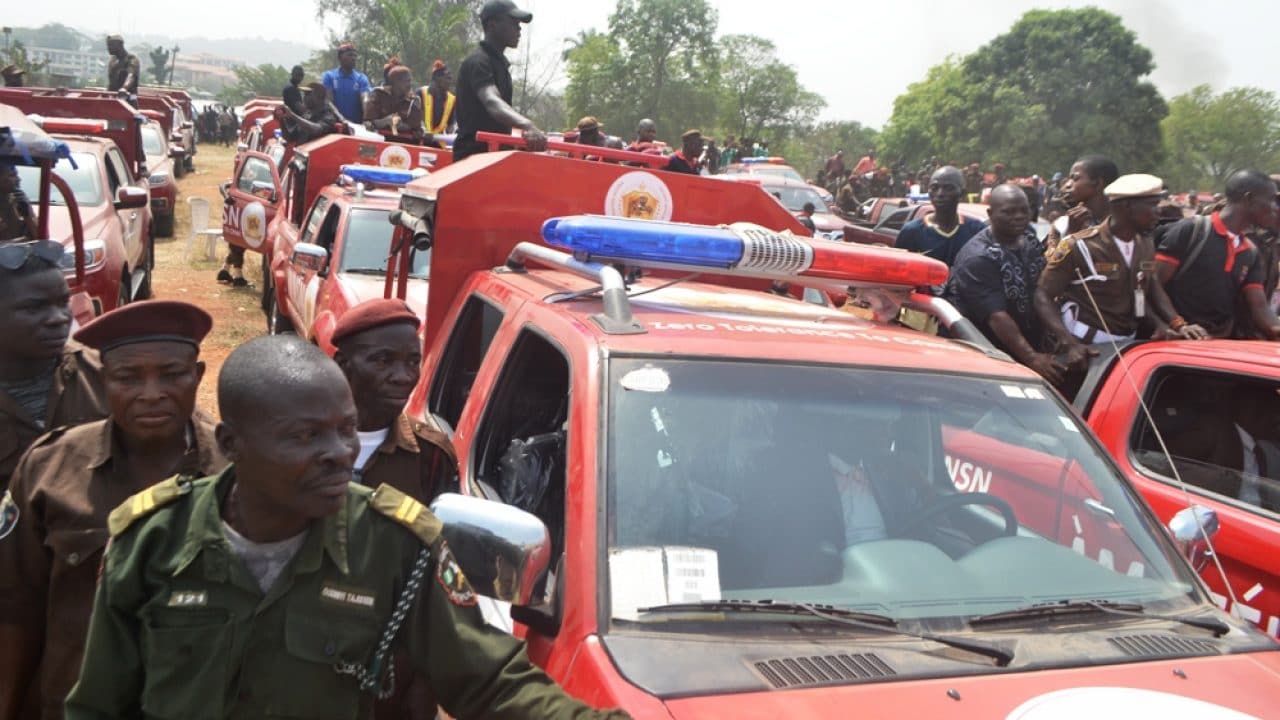
As Nigeria awaits President Bola Ahmed Tinubu’s assent to the State Police Bill, some state governments are considering converting existing security outfits into state police services, while others are developing new structures or awaiting the completion of the constitutional process.
Investigations by LEADERSHIP indicate that states with established security organisations may integrate their personnel, vehicles, facilities and other operational resources into the proposed police services.
However, differences in personnel suitability, recruitment standards, training, funding and operational arrangements could determine how individual states approach the transition.
Imo Govt Set To Transform Vigilante Group
The Imo State Government plans to transform its existing vigilante outfit into a formal police service once the necessary constitutional and legal requirements are fulfilled.
Governor Hope Uzodimma has repeatedly expressed support for state policing, indicating that existing personnel and infrastructure would provide the foundation for the proposed service.
The Commissioner for Information, Declan Emelumba, told LEADERSHIP that the state would not start from scratch because it already had personnel, structures and training facilities.
He said the government would screen existing operatives through vetting, retraining, medical examinations and background checks, while providing appropriate equipment.
“They will be well-equipped to an acceptable standard. We will not start from zero. We have men, we have structure, we have training at Nekede.
“We will do vetting, retraining, medical and background checks, and re-kitting to national standard. Those who fail vetting will be dropped. Fresh recruitment will only fill gaps,” Emelumba said.
He disclosed that vehicles deployed under Operation Search and Flush, a joint security operation involving the state government and police, would also be utilised.
The Police College in Nekede would be transformed into the Imo State Police Training School.
Emelumba added that the State House of Assembly had ratified amendments to the Imo State Police Law drafted by the Ministry of Justice. The government also plans to establish an Imo State Police Service Commission to oversee the proposed institution.
Kogi Ready For State Police, 80% Of Vigilantes May Be Unfit
The Kogi State Government has indicated readiness to establish state police, with plans to consider integrating existing paramilitary groups, forest guards and vigilantes, subject to their suitability.
However, sources close to the State Security Adviser expressed concern that more than 80 per cent of the state’s estimated 2,500 vigilantes might be too old or otherwise unsuitable for formal policing.
The concern could force the government to embark on fresh recruitment and specialised training rather than rely primarily on the existing workforce.
The government would have to determine which personnel could be retained, retrained or excluded from the proposed service.
Governor Ahmed Usman Ododo had, in May, absorbed 1,050 vigilante personnel into the state civil service.
Multiple sources also indicated that the government was considering headquarters accommodation and the establishment of a recruitment committee.
However, the framework for integrating existing personnel, recruitment requirements and operational arrangements remains unclear.
Efforts to reach the State Security Adviser, Commander Jerry Omodara, and the Commissioner for Information and Communications, Kingsley Femi Fanwo, were unsuccessful.
Plateau Govt Sets Up Framework Committee On State Police
The Plateau State Government has inaugurated a 14-member committee to develop the framework for its proposed police service.
Governor Caleb Mutfwang appointed retired Deputy Inspector-General of Police Habila Joshak to chair the committee, which is expected to design the organisational structure, recruitment policy, training curriculum and operational guidelines.
The committee is also responsible for proposing a sustainable funding mechanism.
LEADERSHIP gathered that it had consulted stakeholders across the state’s three senatorial districts and submitted a draft framework to the government.
The proposed service would build on Operation Rainbow, the state’s neighbourhood watch agency comprising hunters, vigilantes and other community security actors.
Governor Mutfwang graduated 1,450 Operation Rainbow operatives in December 2025 for deployment across the state’s 17 local government areas.
Findings indicate that the government intends to audit the personnel, retrain those who meet the required standards and recruit additional operatives to fill identified gaps rather than simply rename the existing organisation.
The transition would depend on the completion of the constitutional amendment process and passage of the Plateau State Police Service Law.
The Commissioner for Information and Communication, Joyce Ramnap, could not be reached for comment.
Bayelsa Awaits Passage Of State Police Law – Diri’s Aide
Unlike states already preparing to integrate existing security structures, Bayelsa says it will wait for the proposed State Police Bill to become law before taking concrete steps.
The Special Adviser on Security to Governor Douye Diri, retired Commissioner of Police Akpoebi Agberebi, said it would be premature to implement provisions of a law that had yet to be enacted.
“My brother, I think we should wait for the National Assembly to do the needful. You don’t start acting on a law that does not exist,” he said.
He added: “The process of making it a law is in progress. But until the law is passed, that is when it will become binding on states to do the needful.”
Agberebi did not indicate whether the government would convert an existing security outfit or establish a new structure.
Kwara: Work In Progress On Establishment Of State Police
The Kwara State Government says it is developing modalities for establishing a state police service but will disclose details after presidential assent to the bill.
The Senior Special Assistant to the Governor on Security Matters, Alhaji Muideen Aliyu, told LEADERSHIP that the passage of the State Police Bill by the state assembly demonstrated its readiness for decentralised policing.
“I cannot give any details now, but I assure you that we are going to do the needful as soon as Mr President assents to the State Police Bill,” he said.
The government has yet to disclose whether existing security structures would be integrated into the proposed service.
Oyo’s Amotekun May Become State Police
Oyo State could build its proposed police service on the existing Western Nigeria Security Network, popularly known as Amotekun Corps.
However, as of November 5, 2026, the state’s legislative approval was yet to be formally transmitted to the National Assembly.
Although the Oyo State House of Assembly passed the Constitution Alteration Bill on September 29, the state was among six yet to communicate their resolutions formally to the National Assembly.
The Senate gave the outstanding states until November 15 to submit their resolutions before forwarding the bill to President Tinubu for assent. It warned that states that failed to meet the deadline could be recorded as withholding approval.
An official of the Ministry of Information, Adekunle Ajayi, said the state had laid the infrastructural groundwork for decentralised policing through Amotekun, whose personnel operate across all 33 local government areas.
He said the government had invested in training, equipment, intelligence networks, command centres and operational logistics.
These resources could provide the foundation for the proposed Oyo State Police Service, although recruitment standards, operational responsibilities and the relationship between Amotekun and the new institution remain to be determined.
Gombe Indicates Readiness
The Gombe State Government has also endorsed state policing, with its House of Assembly passing the proposed constitutional amendment bill on October 23, 2026.
The state already has security personnel under the Gombe State Security, Traffic and Environmental Corps (GOSTEC) and forest guard structures.
In September 2025, the government announced the recruitment of 2,000 GOSTEC personnel to handle traffic management, environmental protection, community safety and public order.
Additionally, the State Executive Council approved N337 million in February 2026 for training 700 forest guards under a national security arrangement coordinated by the Office of the National Security Adviser.
The Commissioner for Finance, Muhammad Magaji, said the personnel were selected from existing vigilante groups and other non-conventional security organisations.
READ ALSO:
- State Police Bill Set for Transmission to Tinubu by National Assembly
- State Police Debate: When Official Numbers Fail to Match the Records
- Police Deny Sowore Was Kidnapped, Clarify Incident in Ado-Ekiti
They subsequently began specialised training at the Mobile Police Training School in Osun State in March, covering surveillance, intelligence gathering and collaboration with conventional security agencies.
However, the government has yet to clarify whether these personnel and structures would be integrated into the proposed state police or retained separately.
Meanwhile, security analysts have argued that outfits such as Hisbah, Amotekun and Ebube Agu would remain distinct from state police and could not automatically be converted into police services. They also argued that such organisations would not be permitted to bear firearms under the proposed framework.
Enugu: State Police Will Not Clash With Other Security Operatives – Mbah’s Aide
The Enugu State Government says its proposed police service will complement existing security agencies rather than create operational conflicts.
The Special Assistant to Governor Peter Mbah on Media, Arinze Nnamani, said the state was ready to embrace the initiative once the bill was signed into law.
Dismissing concerns about possible clashes among security operatives, he said:
“No, no, it is not going to clash; it will only complement, and you know that the President has not signed it.”
Kaduna Yet To Clarify Plans As KADVIS Undergoes Reorganisation
In Kaduna, the state government has yet to disclose whether it would transform the Kaduna State Vigilance Service (KADVIS) into state police or establish a new force.
The Commissioner for Internal Security and Home Affairs, Sule Shu’aibu, did not respond to calls and messages seeking clarification.
However, the ministry’s Permanent Secretary, Bashir Mohammed, and KADVIS Commander, retired Commissioner of Police Ali D. Audu, disclosed efforts to strengthen the organisation through training, improved remuneration and professional supervision.
Mohammed said Governor Uba Sani had prioritised KADVIS’s reorganisation, with about 1,000 personnel trained and a structured remuneration system introduced.
Audu said personnel drawn from the Nigeria Police Force were providing mentorship and professional guidance.
“My experience here is that this is a new agency, and it requires a lot of mentorship and leadership, which we are providing,” he said.
He disclosed that the state government sponsored training for 1,000 personnel, while the Kukah Centre supported the training of 300 command elements. KADVIS also conducted additional in-house training for more than 200 personnel.
However, Audu acknowledged that the organisation still lacked adequate manpower and equipment to meet Kaduna’s security challenges.
The government has yet to clarify whether KADVIS would form the foundation of the proposed state police.
Ondo Yet To Decide Whether To Adopt Amotekun
The Ondo State Government is considering whether to transform Amotekun into a state police outfit or undertake fresh recruitment.
The Commissioner for Information, Idowu Ajanaku, said the decision would be discussed at the State Executive Council meeting.
“We will discuss that at the EXCO meeting. After which we will know if we will adopt Amotekun as state police or begin new recruitment,” he said.
He, however, assured that the state was prepared for the initiative irrespective of the option chosen.
“Whatever is decided, I can assure you that Ondo State is fully prepared for state police,” he added.
Transition Raises Questions About Standards, Funding
The different approaches adopted by the states highlight the challenges of transitioning existing community-based security outfits into formal police institutions.
While Imo and Plateau are developing plans to build on existing structures, Oyo and Ondo are considering the future of Amotekun. Kaduna is reorganising KADVIS, while Kogi faces concerns about the suitability of its vigilantes.
Gombe has invested in training forest guards and other security personnel, while Bayelsa is waiting for the legal process to be completed. Kwara says its modalities are being developed, and Enugu has promised cooperation with existing agencies.
The transition will require uniform recruitment and training standards, sustainable funding, appropriate equipment, professional supervision and clearly defined operational responsibilities.
Although integrating existing personnel could reduce the time and resources required to establish state police, experience in community security operations does not automatically translate into the m qualifications required for formal policing.
Careful screening, retraining and fresh recruitment will therefore be necessary.
States will also need clear operational arrangements with the Nigeria Police Force, military formations and other security agencies to prevent duplication of responsibilities and ensure effective collaboration.
Ultimately, whether states convert existing security outfits or establish entirely new forces, the success of state policing will depend on professional standards, adequate funding, accountability and cooperation among security agencies.
More States Outline Plans For State Police As Constitutional Process Advances
Other states have also expressed varying degrees of readiness to establish state police, although several are awaiting the completion of the constitutional amendment process.
In Nasarawa State, former Majority Leader of the State House of Assembly and former Commissioner for Information, Tourism and Culture, Hon. Abdulhameed Yakubu Kwarra, said the government was awaiting the outcome of the process following the assembly’s concurrence with the National Assembly’s proposal.
Kwarra explained that the proposed amendment seeks to move policing from the Exclusive Legislative List to the Concurrent Legislative List, requiring approval from at least 24 state assemblies.
He said state legislatures would subsequently be empowered to enact laws establishing their respective police forces, while the Police Act would be amended to define their powers and operations.
He added that Nasarawa was prepared because it already had the Na’is community surveillance outfit, comprising community watch, traffic and sanitation units, with more than 10,000 personnel who could provide initial manpower for the proposed police.
In Osun, Governor Ademola Adeleke’s spokesperson, Mallam Olawale Rasheed, said the government would determine its next steps after the National Assembly completed the legislative process and the President assented to the bill.
Similarly, Akwa Ibom Commissioner for Information, Dr Aniekan Umanah, said Governor Umo Eno had made security a priority under his ARISE Agenda.
He disclosed that the state had developed implementation modalities but would await the necessary federal legal framework before commencing operations.
In Ogun, Governor Dapo Abiodun said more than 6,000 personnel of the state-backed Amotekun and So-Safe Corps would be transformed into state police personnel following the passage of the necessary law.
Abiodun, who chairs the governors’ forum on state police creation, said the personnel had acquired relevant training and experience to support the proposed police command. He stressed that effective security was essential for economic growth and sustainable development.
Meanwhile, Kebbi State is yet to announce concrete plans. Its Director of Security, Abdulrahman Usman Zagga, said the government would make the necessary arrangements after the relevant bill received the governor’s assent.
In Niger State, Commissioner for Homeland Security, Barrister Maurice Justin Magaji, said qualified vigilantes could be considered for recruitment, subject to the eligibility requirements in the new legal framework.
He noted that some vigilantes, including older persons, hunters and retired security personnel, might not qualify.
However, Magaji said existing vigilante groups would continue operating alongside the state police because their activities were already backed by state laws.

