

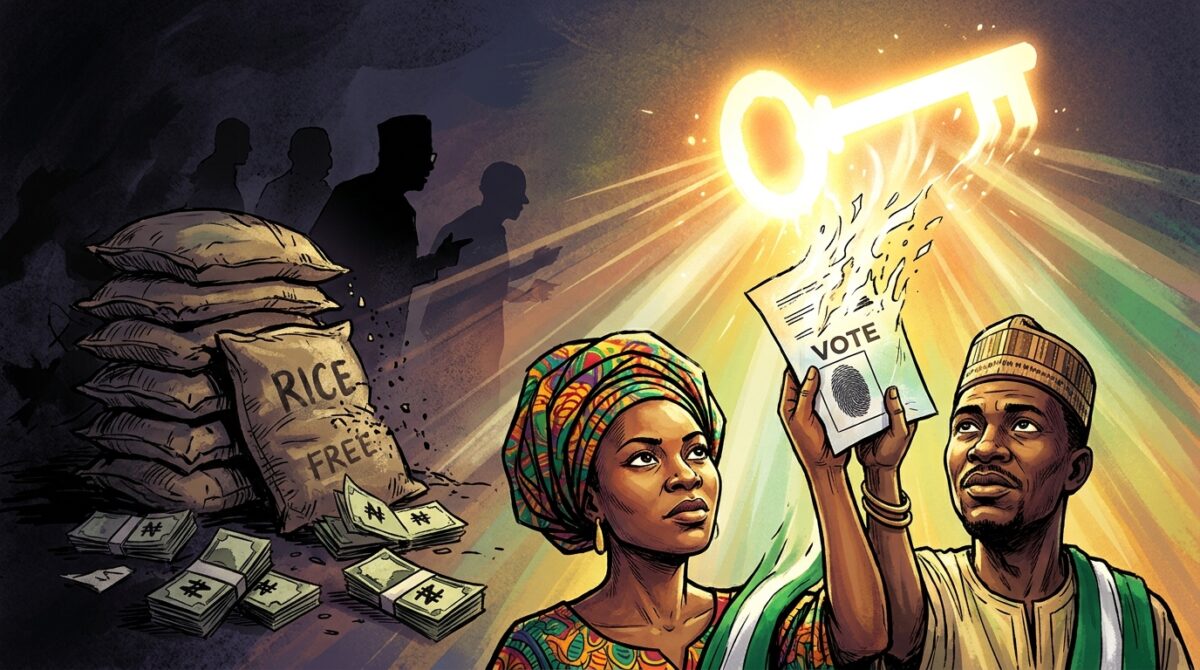
It is approximately two months to the 2027 general election, and electioneering is in full swing, as it should be.
However, there are disturbing developments. Apart from the pockets of political violence that have already cost innocent lives, another unfolding concern is the distribution of goods and money in a way that raises questions about voter inducement and economic empowerment.
Sadly, Nigeria’s increasingly monetised politics is making that distinction difficult. As politicians scramble to build electoral support ahead of the 2027 general elections, cash distributions, material gifts and financial promises are becoming familiar features of political engagement. What is presented, in some circumstances, is little more than an investment in electoral loyalty.
As a newspaper, we do not see anything wrong with politicians using their resources or legitimately appropriated public funds to improve the economic circumstances of their constituents. Indeed, supporting small businesses, assisting farmers, equipping artisans and providing opportunities for disadvantaged citizens are legitimate responsibilities of public office holders.
However, empowerment must be assessed on economic impact, transparency, inclusiveness and sustainability, not by the number of beneficiaries assembled at political gatherings or photographs of cash being distributed, as have emerged of late.
Three incidents stand out in this regard.
The first is the Minister of the Federal Capital Territory (FCT), Nyesom Wike’s recent promise of N10 million to each councillor in the FCT who ensures that President Bola Tinubu wins their ward in the 2027 presidential election.
So, for the 62 wards in Abuja, Wike could well fork out N620 million.
Wike has defended the offer as a reward for political mobilisation, insisting that he did not ask councillors to buy votes but to work for the President’s victory.
Nevertheless, it raises both legal and ethical questions. Why should a public office holder promise such substantial financial rewards based on the electoral outcome of individual wards? Is the money intended for legitimate campaign logistics, or is it a reward for producing a predetermined electoral result?
The distinction is important because the Electoral Act 2026 does not restrict the offence of bribery to cash exchanged directly with voters on election day.
Section 125(1)(a) criminalises the corrupt making of a gift, loan, offer or promise intended to induce another person to procure or endeavour to procure the return of a candidate to elective office or the vote of an elector. The provision also covers the corrupt procurement of electoral outcomes and the financing of bribery. A person convicted under the relevant provision faces a maximum fine of N2 million, imprisonment for 12 months or both.
Significantly, Section 125(3) exempts money genuinely paid for lawful election expenses. This means legitimate campaign expenditure is not criminalised. But describing a financial promise as mobilisation or a reward does not, by itself, establish that it falls within the exemption. The purpose, circumstances and intention behind the offer matter.
Former INEC National Commissioner Festus Okoye has similarly argued that the legal ingredients, including corrupt intention and inducement, must be established before Wike’s pledge can be characterised as an offence. He also cautioned that postponing payment until after an election does not automatically change its legal character.
READ ALSO:
- Nigeria’s Re-Election Into ITU Council A Major Diplomatic Victory – Tinubu
- Accountability Gaps, Procurement Challenges Threaten Nigeria’s Primary Healthcare Gains
- Nigeria Cannot Afford Atiku’s Education Privatisation Agenda-Oshiomhole
A second disturbing incident is the distribution of cash and business support by the Minister of Women Affairs, Imaan Sulaiman-Ibrahim, during a pre-rally empowerment programme in Nasarawa State. Between 100 and 200 women reportedly received N100,000 each, alongside sewing machines, refrigerators and other business equipment. The minister’s involvement in an exercise associated with the First Lady’s grassroots political mobilisation, particularly where
APC-branded materials featured, inevitably raises questions about the separation of government programmes from partisan campaigning.
Similarly, Senator Natasha Akpoti-Uduaghan distributed cash grants ranging from N100,000 to N5 million to constituents, including farmers, tailors, carpenters and small-scale manufacturers, during her third anniversary activities on November 2. The senator explained that the intervention was designed to support businesses and give beneficiaries the flexibility to address their economic needs.
Such interventions may not automatically be called vote-buying. However, the timing, funding, selection criteria and transparency deserve scrutiny, particularly as political actors increasingly deploy direct financial handouts as a means of building public visibility and goodwill ahead of elections.
Genuine empowerment requires transparent selection, measurable outcomes, accountability and sustainability. It should not depend on political loyalty or become a seasonal ritual performed whenever elections approach.
It is regrettable that politicians have formed the habit of capitalising on mass poverty in the country as an instrument of political manipulation.
Nigerians struggling to feed their families need productive opportunities, affordable healthcare, quality education, jobs, infrastructure and social protection, not occasional cash handouts that barely address their circumstances.
Even more troubling is the growing practice of governors using state resources to reward members and supporters of their political parties. In July, Kano State Governor, Abba Kabir Yusuf, distributed 1,540 plots of land and N100 million to leaders of the APC Polling Unit Supporters Association, popularly known as Yan Akwati, to strengthen the party’s grassroots mobilisation ahead of the 2027 elections. In March, Yobe State Governor Mai Mala Buni presented 17 brand-new Honda Accord vehicles to APC local government chairmen to support party operations and grassroots mobilisation.
We wish to state that there is a fundamental difference between a political party using its legitimately raised funds to support its officials and a government deploying resources belonging to all citizens to reward selected party members.
The latter is discriminatory patronage and an abuse of public trust. It deserves unequivocal condemnation, irrespective of the party or governor involved.
A governor holds public assets in trust for all residents, not exclusively for members of his political party. State land, money and other public assets are not party property, and political loyalty cannot be a legitimate criterion for allocating them. Distributing public resources along partisan lines, under whatever guise, is misapplication and misappropriation of public funds.
Therefore, we call upon the Economic and Financial Crimes Commission (EFCC) and the Code of Conduct Bureau (CCB), whose remit it is to investigate and prosecute such infractions, to swing into action. That is one way to strengthen our struggling democracy, for without accountability, this preferred system will continue to underachieve for Nigerians.
Finally, the ballot belongs to the people, and its sanctity must be protected. It must never be allowed to become a commodity for politicians to acquire through cash, gifts, promises or the misuse of public resources.

