

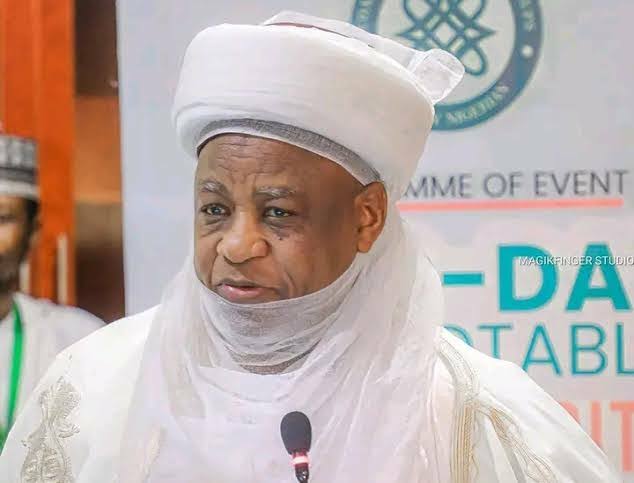
The Sultan of Sokoto, Alhaji Muhammad Sa’ad Abubakar III, has urged Nigerian Muslims to look beyond ethnic and regional differences and promote peace, tolerance and national unity.
Speaking in Ibadan on Sunday, the Sultan said Muslims must remain united in faith and practice, stressing that ethnic differences, family backgrounds and social status should not divide the Ummah or hinder the country’s progress.
He made the appeal at the 11th General Assembly of the Muslim Ummah of South-West Nigeria (MUSWEN), held at the M.O. Abdul Hall, University of Ibadan Central Mosque Auditorium.
The gathering, attended by Islamic leaders, traditional rulers, government representatives and other dignitaries, was held under the theme, “Insecurity in Nigeria: A Technology-Driven and Collective Approach for National Development”.
Abubakar, who is also President-General of the Nigerian Supreme Council for Islamic Affairs, reminded Muslims that they shared a common identity and responsibility as members of one human family.
“We are one big family. Ethnicity should never be a determining factor in identifying who is a Muslim and who is not.
“Almighty Allah created us as one human family and commanded us to worship Him alone and glorify His name,” he said.
He urged Muslims to make the teachings of Islam the foundation of their conduct and relationships, stressing that religious commitment should guide their contributions to society.
“It must be Islam first, Islam first, Islam first, and Islam last,” the Sultan declared.
He maintained that all human beings were equal before Allah, regardless of their social standing or ethnic background, adding that piety and righteousness remained the true measures of human worth.
“Before Allah, we are all equal. The best among us is the one who possesses the greatest degree of piety and righteousness,” he said.
The Sultan also urged Muslim leaders and organisations to remain committed to serving Islam and humanity, warning against allowing ethnic or regional affiliations to undermine the progress of the Ummah.
The Chairman of the MUSWEN Board of Trustees, Dr Abdul Rauf Olawale Babalakin, SAN, called for stronger collaboration among Muslim organisations in the South-West, saying unity and a shared sense of purpose were essential for the community to make greater contributions to society.
Babalakin identified education, technology and sustainable funding as key pillars for the organisation’s growth.
He also urged Muslims to reject extremism and embrace peaceful engagement, noting that stronger institutional structures would enable MUSWEN to achieve its objectives more effectively.
READ ALSO:
- Family Accuses Abductors Of Betrayal As 47-year-old Kaduna Farmer Killed After N56m Ransom
- Troops Repel Terrorists’ Attacks In Zamfara, Neutralise One, Recover Weapons In Kaduna
- 2027: Don’t Choose Leaders Based On Religion, Ethnicity — Jonathan Warns Nigerians
In his address, the immediate past MUSWEN President, Alhaji Rasaki Oladejo, reviewed the organisation’s achievements during his six-year tenure, highlighting progress in property development, financial management, educational support and conflict resolution.
He said his administration had worked to strengthen the organisation’s financial position and establish sustainable structures for future activities, with an emphasis on investments and programmes that benefit the wider Muslim community.
Oladejo also announced plans to award scholarships to 12 female medical students under the Sultan Abubakar Female Medical Student Scholarship Scheme.
The beneficiaries are expected to be drawn from the six South-West states, with two students selected from each state.
He added that MUSWEN planned to award 120 bursaries in 2027.
In his acceptance address, the new MUSWEN President, Alhaji Rafiu Adisa Ebiti, pledged to build on his predecessor’s achievements and reposition the organisation to play a stronger role in education, healthcare, economic development and the empowerment of women and young people.
He said his administration would pursue programmes that directly addressed the needs of the Muslim community while promoting national unity and peaceful relations among people of different religious backgrounds.
“We want a MUSWEN that is more responsive to the needs of the people, particularly in education, healthcare, economic empowerment and the development of our youths and women. Our responsibility is to build on the achievements of the past and make the organisation more effective,” Ebiti said.
On the country’s security situation, the new president condemned banditry, kidnapping, terrorism and communal violence, calling for improved intelligence-sharing and closer cooperation between security agencies and local communities.
He also stressed the need for accountability within security institutions and advocated consideration of constitutionally grounded decentralised policing as part of a broader strategy to tackle insecurity.
“Security cannot be left to government agencies alone. There must be effective cooperation between security institutions and local communities, supported by timely intelligence, accountability and a system that can respond adequately to the peculiar security needs of different areas,” he said.

