

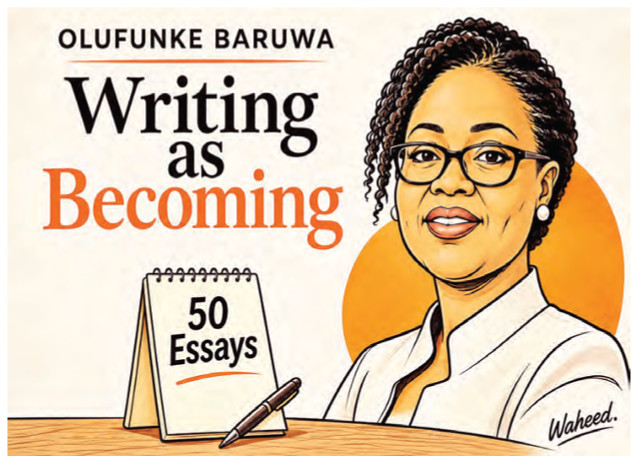
The book’s significance is particularly personal. Launching it on my 50th birthday was deliberate and deeply meaningful: 50 years of life, experience and learning; 50 essays reflecting years of writing, observation and engagement with the questions shaping our society. The number connects a personal milestone with an intellectual journey and marks a transition from being a writer who uses public space to interrogate issues to becoming an author whose work is preserved in a single volume.
This is more than a collection of newspaper articles. It documents a society in transition, captures the contradictions of our democracy and asks uncomfortable questions about the responsibilities of those who govern and those who are governed.
As we know too well, societies do not collapse only because of bad policies; they collapse when truth itself loses value.
Fifty Essays, One Continuing Conversation
In a country where public memory is often short and yesterday’s controversies are quickly displaced by today’s headlines, preserving these reflections matters. Newspaper columns capture the urgency of the moment; a book gives them another life, allowing readers to revisit the arguments and consider what remains unresolved.
The Value of Critical Voices
A book is ultimately a conversation between its author and readers. That conversation becomes richer when others bring their experiences and perspectives to its pages.
The thoughtful review by Toyin Akinniyi, Luminate’s Regional Director, Africa, offers an important independent engagement with the collection, inviting readers to consider both the issues addressed and the larger purpose of writing about public life: to question, provoke reflection and contribute to the search for better ways of organising society.
The endorsements by Dr Ndidi Nwuneli – Executive Chair, Sahel Consulting/Co-Founder, Wealth4Impact; Josephine Effah-Chukwuma – Executive Chair, Innocent C. Chukwuma Foundation; Dr Joe Abah – Regional Director for Africa, DAI; and Dr Kole Shettima – Africa Director, MacArthur Foundation add valuable perspectives. Their work across philanthropy, civil society, government, entrepreneurship, institutional development and social impact reinforces the importance of moving beyond ideas to practical action. This is central to the book’s argument: governance must ultimately be judged by whether it improves people’s lives.
The congratulatory letter from United Nations Deputy Secretary-General Amina J. Mohammed is a special honour.
The five section reflections by Dr Abiola Akiyode-Afolabi – Executive Director, Women Advocates, Research and Documentation Centre; Zeal Akaraiwe – Group CEO, FMDQ; Dr Amina Salihu – Deputy Director, Africa Office at MacArthur Foundation; Prof Chidi Anselm Odinkalu – Prof. of Practice, International Human Rights Law, Fletcher School of Law and Diplomacy at Tufts University; and Cheta Nwanze – CEO, SMB Intelligence, further demonstrate the value of engaging public questions from different vantage points.
READ ALSO:
I am grateful to these voices and to everyone who worked behind the scenes on the compilation. Authorship should not be confused with ownership of every conversation. Writing may begin with an individual, but its value is tested by the questions it provokes and the conversations it makes possible.
Democracy Requires More Than Spectators
At the heart of this collection is a conviction that democracy cannot survive on elections alone. Elections are essential, but they are not the final measure of democratic life. Accountability, justice, inclusion, institutional integrity and the protection of citizens’ rights matter just as much.
Nigeria’s experience makes this distinction urgent. We have witnessed persistent insecurity, eroding public trust, the exclusion of women and other marginalised groups from decision-making, and institutions repeatedly failing to deliver the outcomes citizens expect. Technology is also reshaping political participation, public information and the exercise of power, creating opportunities alongside new forms of manipulation and exclusion.
These challenges cannot be resolved by governments alone. Political parties must become more accountable; public institutions must serve citizens rather than individual interests. The media and civil society must retain the courage to scrutinise power, while the private sector must recognise responsibilities beyond profit. Citizens, too, must move beyond periodic outrage and electoral participation to sustained civic engagement.
One underlying argument of Writing as Becoming is that democracy is not a spectator sport. It requires participation, vigilance and the willingness to hold power accountable, even when inconvenient.
The Unfinished Business of Becoming
Turning 50 has made this publication especially reflective. It is an opportunity to look back, not with the illusion that everything has been accomplished, but with gratitude for the experiences, people and public conversations that have shaped my journey.
The 50 essays represent a selection of that journey. They remind me that writing is not merely about producing words or filling a newspaper page. It is about taking positions, asking difficult questions, challenging complacency and accepting that words carry consequences. A writer must keep interrogating the present; an author also has the privilege and responsibility of preserving ideas for readers beyond the immediate moment.
Neither milestone represents an ending. There are still difficult questions to ask, institutions to challenge, stories to tell and possibilities to imagine.
I hope readers find in these essays not necessarily agreement with every argument, but an invitation to think critically about the society we are building and the part each of us must play.
We cannot outsource the responsibility for building a better society to the people we elect. Democracy belongs to all of us, and so does its unfinished business.

