

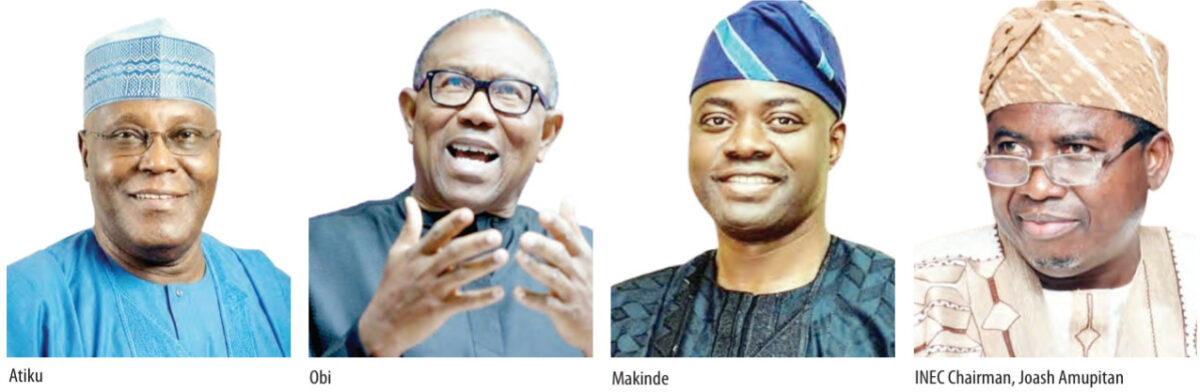
ADC, NDC, APM candidates sure of emerging preferred choice
As political activities ahead of the 2027 general election gather momentum, Nigeria’s opposition parties face a familiar but difficult question: Can leaders with competing presidential ambitions set aside their individual interests to build a common front against the ruling All Progressives Congress (APC)?
The question has become increasingly important as former Vice President Atiku Abubakar, former Anambra State Governor Peter Obi and Oyo State Governor Seyi Makinde remain central to consultations aimed at strengthening opposition cooperation.
The opposition’s November 30 summit in Abuja is expected to provide another opportunity for participating parties to demonstrate their commitment to cooperation. However, whether the meeting can resolve the deeper disagreements surrounding the presidential contest remains uncertain.
The Coalition for Democracy, comprising six opposition parties and factions—the African Democratic Congress (ADC), Nigeria Democratic Congress (NDC), Allied Peoples Movement (APM), a Peoples Democratic Party (PDP) faction, the Peoples Redemption Party (PRP) and the Social Democratic Party (SDP)—is seeking to establish a framework for political cooperation ahead of the election.
Coordinated by former APC National Vice-Chairman, Salihu Lukman, the coalition has been working towards a formal agreement on democratic renewal, electoral integrity and opposition collaboration.
Beyond signing agreements, however, its biggest challenge is establishing a workable arrangement around the presidential ambitions of its leading figures.
The Atiku-Obi Question
At the heart of the negotiations is the relationship between Atiku and Obi, two prominent opposition politicians with substantial political followings and competing presidential ambitions.
Atiku, who contested the 2023 presidential election on the PDP platform, is now ADC’s presidential candidate, while Obi is contesting under the NDC.
Any arrangement requiring either politician to support the other would involve considerable political concessions.
For Atiku, withdrawing would mean abandoning an ambition he has pursued despite previous electoral defeats.
For Obi, stepping aside could raise questions about the future of the political movement built around his 2023 presidential campaign and the expectations of supporters who want him to contest again.
Atiku’s position has become more emphatic following his rejection of reports that he had withdrawn from the 2027 presidential race.
In a statement issued on November 22 by his Director of Strategic Communication, Phrank Shaibu, the former vice-president described the reports as a “brazen, malicious and desperate falsehood”, insisting that he had made no such decision.
He also warned that no group claiming to be his supporters could speak on his behalf or announce his withdrawal.
“Putting my name on a placard does not make someone my supporter. Putting a lie in that person’s mouth does not make it my decision,” he said.
In an indication of his position ahead of the coalition negotiations, Atiku declared that he was not prepared to step aside for another opposition candidate.
“I do not need anyone to step down for me, and I am stepping down for no one,” he said.
He accused any political party promoting reports of his withdrawal of working in favour of President Bola Tinubu, arguing that such claims could weaken the opposition by creating the impression that one of the president’s strongest challengers had left the race.
“Any party promoting the lie that I have stepped down is doing Tinubu’s work. Every false withdrawal story tries to clear his strongest opponent from the field. If I am not on the ballot, Bola Tinubu might as well wait for a coronation. But I am in this race to win, and Nigerians will have their choice,” he said.
Atiku also maintained that his Affordable Life campaign was continuing nationwide, focusing on the economic hardship facing Nigerians.
“Hunger and poverty are not on social media. They are in our markets, our homes and every community where families struggle to afford food and transport. That is why our campaign is going to every nook and cranny of Nigeria,” he added.
He urged supporters to remain focused, mobilise nationwide and keep their Permanent Voter Cards ready, insisting that no fabricated declaration could withdraw him from an election he intended to win.
His categorical position raises questions about how the coalition intends to reconcile his ambition with the proposed common-candidate arrangement.
Recent developments have further exposed the divisions within the opposition. A coalition of support groups previously associated with Atiku reportedly endorsed an Obi-Kwankwaso joint ticket, even as the former vice-president dismissed reports of his withdrawal.
The development illustrates how the debate has extended beyond consultations among party leaders to competing interests among political support groups. It also highlights the distinction between endorsements by supporters and formal decisions by presidential candidates.
However, the National Publicity Secretary of the Nigerian Democratic Congress (NDC), Osa Director, has argued that Obi stepping down should not be the starting point of discussions about a common opposition candidate.
“It is not a matter of Peter Obi stepping down, but we are talking about organic movement and the man who is acceptable to all,” he said.
His position introduces another dimension to the negotiations, particularly as supporters of different political figures continue to debate who has the strongest electoral appeal and should lead the opposition.
Makinde’s Position Adds Another Dimension
The emergence of Makinde as another important figure in the negotiations further complicates the search for a consensus candidate.
The Oyo State governor, who is the APM’s presidential candidate, has also participated in consultations with Atiku and Obi. His involvement means the negotiations are not simply about finding an understanding between two leading opposition politicians but accommodating multiple political actors with different ambitions, party structures and expectations.
Makinde’s position also raises questions about the criteria for selecting a common candidate. Should the decision be based on party strength, political experience, geographical considerations, previous electoral performance or an agreed process involving all participating parties?
READ ALSO:
- 2027: Atiku’s Ambition Threatens Power Rotation, Says CNDS
- Makinde Says Opposition Coalition Will Emerge To Remove Tinubu In 2027
- 2027: Wike Mocks Lulu-Briggs Over 23-Year Governorship Ambition, Compares Him To Atiku
Without an acceptable selection mechanism, the negotiations could become another contest over who should make the ultimate sacrifice.
The National Publicity Secretary of the Allied Peoples Movement (APM), Abubakar Yusuf, however, expressed optimism that Makinde could emerge as the opposition coalition’s consensus candidate.
He said Makinde’s emergence would depend on the political dynamics of the current dispensation, adding that either the Oyo governor could emerge as the consensus candidate or the two other leading contenders could concede the ticket to him.
Yusuf also alleged that the ruling party was manipulating the courts to its political advantage, arguing that opposition leaders must be prepared to make concessions if they were serious about wresting power from the APC.
Party Crises And Questions Of Trust
Beyond individual presidential ambitions, internal party disputes constitute another major obstacle to the coalition project.
Such disagreements could complicate coalition participants’ ability to make binding political commitments.
Where participating parties suspect that others are seeking to dominate the arrangement, reaching a lasting understanding becomes considerably more difficult. Consequently, disagreements over political concessions could prove as important as the question of who eventually secures the coalition’s support.
The Electoral Clock Is Another Challenge
The opposition’s efforts are also unfolding against an increasingly restrictive electoral timetable.
Under the Electoral Act 2026, the deadline for ordinary withdrawal of presidential candidates for the January 16, 2027 election fell on October 18, 2026.
Consequently, the coalition must distinguish between producing a legally recognised common candidate through the ordinary withdrawal process and agreeing on political cooperation around candidates already nominated by their respective parties.
A political agreement does not automatically remove other candidates from the ballot. The parties could still explore coordinated campaigns, political endorsements and other forms of electoral cooperation, subject to applicable legal provisions.
Any arrangement must, however, take account of existing nominations and the legal framework governing the election.
What November 30 Must Resolve
The November 30 summit presents an opportunity for opposition parties to clarify the direction of their proposed alliance.
The coalition must also explain how its proposed agreement will address the earlier ambition of developing a roadmap towards a common presidential candidate.
Lukman has acknowledged that the selection mechanism remains unresolved and that the presidential candidates must be involved in the negotiations.
He said the coalition must establish a transparent and acceptable selection process and persuade other aspirants to support the outcome, stressing that concrete political commitments must back declarations of unity.
This leaves a central question unanswered: What happens if the candidates cannot agree on who should lead the proposed alliance?
Atiku’s November 22 declaration has made the question more pressing, given his insistence that he will not step down for anyone. The coalition must therefore determine whether it can achieve consensus without requiring him to abandon his ambition or whether the disagreement will undermine the search for a single candidate.
The opposition parties could settle for a framework that allows them to retain their individual presidential candidates while cooperating on specific electoral issues. Alternatively, they could pursue a more coordinated arrangement around one of the existing candidates.
Either option would require considerable political understanding and clearly defined commitments.
Beyond Personal Ambitions
Ultimately, the challenge facing the opposition is whether its leaders can translate their shared interest in political cooperation into an arrangement that accommodates the competing interests of participating parties.
The November 30 summit may provide an opportunity to demonstrate progress, but the real test will be the coalition’s ability to resolve the difficult questions that have remained unanswered.
For Atiku, Obi, Makinde and other opposition figures, the negotiations involve more than signing an agreement or appearing together at a political gathering. They must determine how much they are prepared to concede, what guarantees they expect in return and whether their supporters will accept the eventual arrangement.
Atiku’s emphatic rejection of reports of withdrawal has underscored the scale of the challenge, particularly as the coalition seeks to convince leading opposition figures that unity may require difficult political compromises.
With the 2027 election approaching, the opposition’s ability to manage these competing interests will remain central to the survival and success of its coalition project.

