

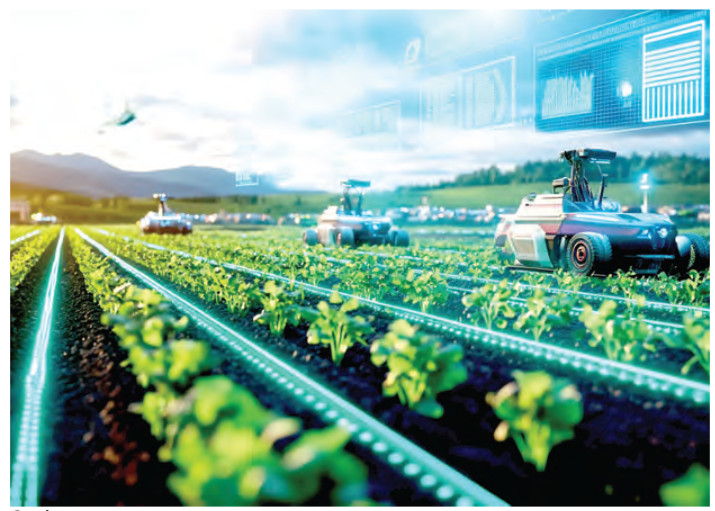
As Nigeria continues to grapple with food insecurity and post-harvest losses, artificial intelligence could help agribusinesses address poor management, operational inefficiencies and wastage across the food value chain. SILAS EZEUGWU writes.
Nigeria’s food security debate has largely centred on increasing agricultural production through fertiliser distribution, mechanisation, irrigation and expansion of cultivated land. But experts say another critical part of the problem lies beyond the farm: the management of harvested produce, processing facilities, warehouses and distribution networks.
For Emmanuel Atule Negedu, an agriculture technology expert and entrepreneur, increasing production without addressing inefficiencies across the agricultural value chain will deliver limited results.
He argues that Nigeria must pay greater attention to how agricultural businesses manage their resources, machinery, inventories, workers, finances and supply chains, as poor coordination in these areas contributes to avoidable losses.
“Producing more food will not deliver its full benefits if the businesses responsible for processing, storing and distributing it are poorly managed,” he says.
Negedu, whose company, Riverale Farms & Agritech Ltd, popularly known as Riverale Agtech, has developed an artificial intelligence-powered agricultural management platform called AgriPal, believes technology could help address some of these shortcomings.
The platform, which is now operational, integrates different aspects of agribusiness management into one digital system, allowing owners and managers to monitor operations, identify problems and make decisions using business data.
His proposition comes against the backdrop of Nigeria’s considerable agricultural potential and persistent food insecurity.
According to Negedu, agriculture contributed 27.8 per cent of Nigeria’s rebased N372.8 trillion Gross Domestic Product in 2024, representing more than N100 trillion. The sector also provides livelihoods for a significant proportion of the country’s workforce.
Yet, its economic contribution has not translated into a food value chain capable of consistently delivering affordable food, minimising post-harvest losses and supporting profitable agricultural enterprises.
The Cost Of Poor Management
A commercial farm or processing company requires more than productive land, good seeds and fertiliser. It must coordinate procurement, production, machinery, personnel, inventory, accounts, sales, logistics and distribution.
Poor inventory records can lead to unnecessary purchases or shortages of raw materials. Delayed equipment maintenance can leave expensive machinery idle, while inadequate financial monitoring can conceal rising production costs. Similarly, poor coordination between processing and sales departments can prevent businesses from meeting customer orders.
Negedu illustrates the problem with a rice mill in Ogun State during the harvest season.
Trucks carrying paddy arrive in large numbers, storage facilities approach capacity and buyers await their orders. Suddenly, a critical processing machine breaks down.
He said production slows, but the maintenance team needs management approval before repairs can begin. Meanwhile, the head office struggles to establish how much paddy remains in storage, which orders are outstanding and whether the business is operating within its budget.
Because information is scattered across departments, management cannot immediately assess the situation. By the time the relevant information is assembled and decisions taken, the mill may have lost valuable production hours and revenue.
A digitally integrated system, however, could notify management immediately, provide relevant operational information and enable faster decisions on repairs and other interventions.
“That difference in response is what AgriPal is designed to achieve,” Negedu explains.
The implications extend beyond the profitability of individual businesses. Post-harvest losses remain a major challenge in Nigeria, with inadequate storage, poor handling, transportation difficulties and processing bottlenecks contributing to food wastage.
Negedu cites estimates from the African Postharvest Losses Information System indicating that Nigeria lost approximately 954,000 tonnes of rice after harvest in 2020, valued at more than $970 million. The country also lost over 2.1 million tonnes of maize.
Such losses are particularly troubling in a country where millions struggle to access sufficient food.
The October 2026 Cadre Harmonisé analysis, released by the Federal Ministry of Agriculture and Food Security in collaboration with the Food and Agriculture Organisation, found that 26.8 million Nigerians were facing a food crisis or worse. The figure is projected to rise to 33.5 million during the June–August 2027 lean season.
For Negedu, these figures reinforce the need to reconsider the conventional approach to food security.
“That is an often-overlooked dimension of food security. We must look beyond production and pay equal attention to how food is handled throughout the value chain,” he says.
His argument is that food security is not determined solely by the volume harvested. The ability to preserve, process, store and distribute agricultural produce efficiently is equally important. A country can increase agricultural production and still struggle with food availability if substantial quantities are lost before reaching consumers.
Taking Agribusiness Digital
AgriPal is designed to address these management challenges by connecting activities that many agricultural businesses currently handle through separate systems.
Its functions cover farm and production operations, agronomy, processing and milling, equipment maintenance, finance, human resources, sales and logistics.
Rather than relying entirely on notebooks, spreadsheets, telephone calls and WhatsApp messages to coordinate departments, businesses can use a central digital system to monitor their activities.
Its dashboard provides an overview of operations across different locations, while reports and geographical mapping help managers monitor activities at farms, warehouses and processing facilities. Notifications, including updates through WhatsApp, are also designed to ensure that relevant information reaches personnel without unnecessary delays.
This could be particularly useful to agricultural businesses operating across several locations, where owners cannot always be physically present to supervise activities.
Negedu says the platform is not intended to replace the people responsible for running agricultural enterprises.
“AgriPal is not designed to replace farmers, agronomists, engineers or managers. Rather, it provides the structure and reliability needed to improve coordination between management and workers,” he says.
What AI Brings To The Table
READ ALSO:
- Obi Urges Nigeria To Expand Grassroots Sports Beyond Talent Discovery
- Mike Tyson, Eminem’s Bond Goes Beyond Music And Boxing
- 2027: Tinubu’s Reforms Yielding Positive Results, Nigeria Won’t Be Handed To Political Gamblers – Wike
Although digital management systems are not entirely new to agriculture, Negedu believes artificial intelligence offers an additional advantage by enabling businesses to move beyond recording activities to analysing information and identifying emerging problems.
Agricultural enterprises generate considerable data daily. Production figures, inventory records, maintenance reports, financial transactions and sales information all contain indicators of business performance. However, when these records are scattered across departments, identifying relationships and emerging operational problems becomes difficult.
AgriPal is designed to analyse information from different business operations and translate it into practical management insights.
For instance, it can help identify equipment requiring urgent maintenance, declining stock levels that could disrupt production and rising operational costs that may eventually erode profitability.
Instead of waiting for a problem to become a crisis, managers can receive information that helps them respond earlier.
“AI is at the heart of AgriPal. It is what transforms an ordinary management system into a strategic business tool,” Negedu says.
The platform also incorporates an artificial intelligence assistant that allows managers to ask questions in ordinary language about their business operations.
A manager seeking information about outstanding maintenance issues, production performance over a particular period or the status of an operation can ask the assistant instead of manually examining several reports.
“You do not have to be a data analyst to manage your business using data,” he says.
Other capabilities being considered or integrated include cameras, sensors and monitoring tools, alongside weather intelligence, crop-disease modelling and yield projections. These are intended to extend digital monitoring to actual farm operations and help businesses anticipate potential challenges.
Technology Meets Agriculture
Negedu’s interest in combining technology with agriculture is rooted in an academic and professional background spanning both disciplines.
He holds a Bachelor’s degree in Computing from the University of Portsmouth and a Master’s degree in Agricultural Technology and Innovations from the Royal Agricultural University, both in England.
He is also a Certified AI Engineer with the United States Artificial Intelligence Institute and has professional experience in software engineering, cloud computing and machine learning.
Beyond the technical possibilities, he says his interest in agricultural technology is driven by a commitment to addressing food insecurity.
“I have a burning passion to help curb food insecurity, both in Nigeria and around the world,” he says.
He is concerned about the persistence of hunger in a country with substantial agricultural resources and the tendency to accept avoidable inefficiencies as normal features of doing business.
He points to situations in which good harvests are lost because of inadequate storage, processing facilities remain idle because of poor coordination, and agricultural businesses struggle to expand because of weak management.
“To me, innovation means refusing to accept these problems as inevitable when practical solutions can be developed to address them,” he says.
The Limits Of Technology
Despite his confidence in AgriPal’s potential, Negedu acknowledges that technology alone cannot resolve the structural challenges confronting Nigerian agriculture.
Insecurity, poor rural roads, inadequate infrastructure, expensive financing and limited access to agricultural extension services remain major obstacles. A digital platform cannot build roads to isolated farming communities, guarantee farmers’ security or make credit affordable.
Rather, he believes it can help agricultural businesses operate more efficiently despite the difficult environment.
He also sees a relationship between improved business management and access to finance. Agribusinesses with reliable records of their activities, financial performance and operational costs are better positioned to demonstrate their viability to prospective lenders.
This is important in a sector that continues to struggle with limited access to formal financing.
“Despite agriculture’s significant contribution to the economy, the sector receives only about five per cent of bank lending, according to Central Bank of Nigeria data,” he says.
Although reliable records cannot guarantee loan approval, they can help businesses present a clearer picture of their operations and financial standing.
With AgriPal now live, Negedu’s immediate challenge is to demonstrate its usefulness in actual agricultural operations. Its adoption will depend on whether businesses can achieve measurable improvements in inventory management, equipment utilisation, expenditure monitoring and decision-making.
There are also practical barriers to technology adoption, including investment costs, unreliable connectivity, inadequate training and resistance to changing established management practices. These factors will determine whether the platform gains wider acceptance among agricultural businesses.
Ultimately, Negedu’s argument goes beyond the prospects of one technology venture.
He believes Nigeria’s agricultural transformation requires a broader understanding of productivity.
Expanding cultivated land, distributing more farm equipment and increasing production remain important. But these interventions will have limited impact if agricultural businesses cannot efficiently manage the resources, processes and products already available to them.
“The next major breakthrough in Nigerian agriculture may not necessarily come from putting another tractor in the field or bringing another hectare of land under cultivation.
It could come from developing smarter systems that enable agribusinesses to understand their resources, anticipate challenges and make better decisions,” he says.
Whether artificial intelligence can deliver the improvements envisaged will depend on its practical application, affordability and measurable impact.
But the intervention raises an important question for policymakers and agricultural businesses: while Nigeria concentrates on producing more food, is it paying enough attention to the systems needed to ensure that food already produced is not wasted?
For Negedu, efficient management must become an essential component of agricultural productivity rather than an administrative concern addressed after production.
“The future of agriculture is not just about growing more. It is about managing better, producing smarter and making every resource count.”

