

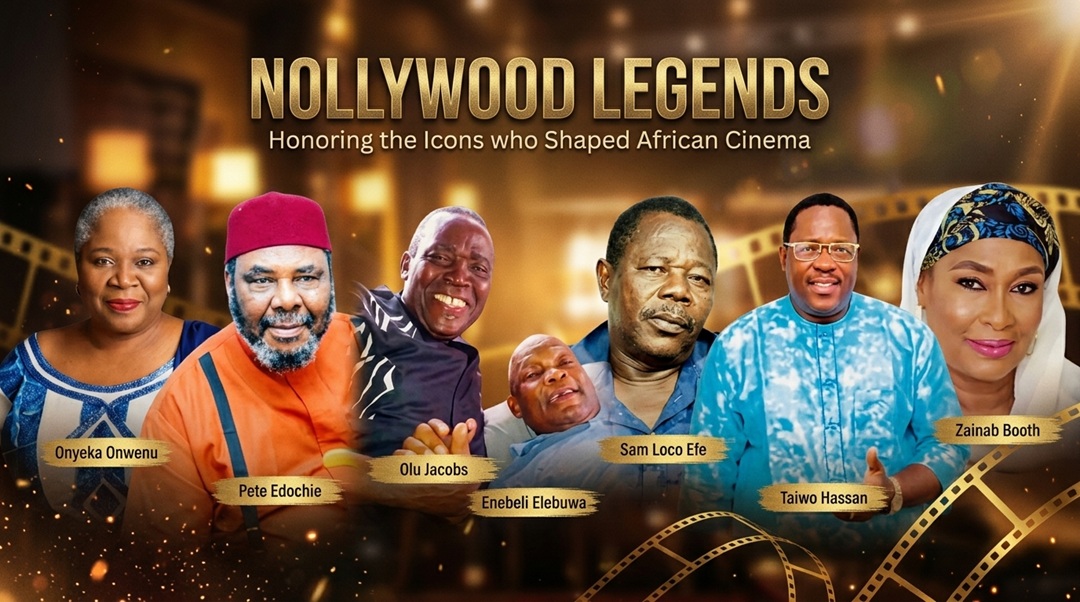
The departed, the ageing and the ailing legends whose sacrifices helped build Nigeria’s film industry now confront a troubling legacy of unanswered welfare questions. Beyond the fame, applause and celebrated performances lies a difficult reality: who cares for Nollywood’s stars when the cameras stop rolling? ZULEIHAT CHATTA examines the industry’s unresolved questions about actors’ welfare, financial security and the price of a lifetime in the spotlight.
They made us laugh when life offered little reason to smile. They made us cry, challenged our emotions, entertained our families and gave Nigerian stories faces, voices and identities that audiences would remember for generations.
They were the kings, village chiefs, wealthy businessmen, wicked mothers-in-law, traditional rulers, comedians and unforgettable villains who helped define the golden years of Nigerian cinema.
For decades, their faces dominated television screens and home-video collections. Their performances helped transform Nollywood from a fledgling filmmaking enterprise into an internationally recognised cultural force.
But behind the applause, awards, celebrity status and glamour of premieres lies a troubling question: what happens to the people who built the industry when the cameras stop rolling?
For some, the answer has been death. For others, it has been prolonged illness, ageing, dwindling opportunities and financial uncertainty. And for those still working, the question of whether years of creative labour translate into long-term financial security remains largely unanswered.
The recent deaths of veteran actors Olu Jacobs, 84, and Pete Edochie, 79, have brought renewed attention to the vulnerability of Nollywood’s pioneering generation.
Their departures, alongside those of Francis Duru, Taiwo Hassan, Kola Oyewo, Alexx Ekubo and other performers reported dead in 2026, have added urgency to a conversation that should extend beyond condolence messages, emotional tributes and social media remembrances.
The concern is not that every veteran actor is poor or that the industry has abandoned all its older practitioners. Some have successfully invested, established businesses and secured financial independence. Others continue to work and earn comfortably.
However, the absence of a universally dependable safety net raises serious questions about those who may not have enjoyed similar opportunities.
For veteran actor and filmmaker Tony Akposheri, a former Vice-President of the Directors Guild of Nigeria (DGN), the problem is particularly evident in the dwindling opportunities available to older practitioners.
The Actors Guild of Nigeria (AGN), however, maintains that welfare structures exist to support members.
Its National President, Abubakar Yakubu, says the guild operates health and general insurance arrangements, alongside other interventions designed to assist members facing difficult circumstances.
Between these two perspectives lies the central question confronting Nollywood: has an industry that has generated fame, wealth and international recognition done enough to protect the people whose talent helped build it?
The Giants We Have Lost: When Tributes Replace Protection
Nollywood’s history cannot be told without remembering the actors whose performances gave the industry its character.
Sam Loco Efe, who died in 2011, remains one of the most distinctive comic actors Nigeria has produced. His remarkable timing, facial expressions and ability to transform ordinary dialogue into unforgettable comedy made him a household name.
That same year, the industry lost Ashley Nwosu and Geraldine Ekeocha, performers whose contributions helped shape its evolving story.
In 2012, Pete Eneh and Enebeli Elebuwa died. Elebuwa, remembered for his commanding screen presence, was among the actors whose performances helped establish the popularity of Nigerian home-video productions.
The following year, Justus Esiri, one of Nigeria’s most respected stage and screen performers, passed away. His career extended beyond Nollywood into international television and theatre.
Dede One Day died in 2015, while Bruno Iwuoha, another familiar face in Nigerian cinema, died in 2021.
The industry also lost Saint Obi in 2023, followed by John Okafor, popularly known as Mr Ibu, in March 2024 after a prolonged health battle.
Mr Ibu’s medical struggles attracted national attention. Colleagues, friends and members of the public rallied around him, with fundraising efforts drawing attention to the financial demands of serious illness.
His death raised further questions about the vulnerability of entertainers who, despite years of public recognition, may not have comprehensive medical protection.
Also on the list is John Paul Obumneme Odonwodo, popularly known as Jnr Pope, an actor and film producer. He died on 10 April 2024 in a tragic boat accident on the River Niger while travelling to a movie location in Asaba, Delta State. He is remembered for his energetic acting, especially in action, crime and villain roles.
Then Came Another Painful Chapter In 2026:
Olu Jacobs, a towering figure whose career spanned theatre, television and film, died at 84 on September 16. His contributions to Nigerian entertainment, including his work alongside his wife, actress Joke Silva, remain part of the industry’s institutional memory.
His publicly disclosed battle with dementia had already drawn attention to the health challenges confronting ageing performers.
On November 25, the industry suffered another monumental loss with the reported death of Sir Pete Edochie at 79.
Best remembered for his portrayal of Okonkwo in the television adaptation of Chinua Achebe’s Things Fall Apart”, Edochie became one of Africa’s most recognisable actors. His commanding voice, cultural depth and memorable interpretation of traditional authority figures made him an enduring presence in Nigerian cinema.
The 2026 losses also include Francis Duru, Taiwo Hassan, popularly known as Ogogo, Kola Oyewo, Alexx Ekubo, Temitope Osoba, Taiwo Adeshina, Oby Kechere and Solomon Akiyesi, according to a November 25 report by QED.
The deaths span generations, from established pioneers to younger performers whose careers were still developing.
Each loss has prompted tributes celebrating the actors’ contributions. But the larger question remains: how much of the appreciation expressed after their deaths is translated into meaningful protection for those still alive?
It would be unfair to assume that every deceased actor died in poverty or without family support. Their personal circumstances differed. However, their stories collectively reinforce the need for a dependable system that protects practitioners against medical emergencies, financial insecurity and the uncertainties of ageing.
The Living, The Ageing And The Uncertain Future
The truth is , the welfare conversation must not end with those who have died.
Nollywood still has a generation of veteran performers whose experience, talent and contributions remain valuable to the industry.
Some continue to secure roles, while others have become less visible as production trends, audience preferences and casting patterns change.
For many, the challenge is not necessarily the absence of fame. It is the difference between being famous and being financially secure.
An actor may have featured in hundreds of productions without necessarily having a pension, regular royalty income, comprehensive medical insurance or a dependable source of income during periods without work.
This is particularly important in an industry where engagements are frequently project-based.
This is because, unlike workers in conventional salaried employment, many actors do not have guaranteed monthly earnings. They may receive payment for individual productions, but what happens when engagements become irregular?
The question becomes even more pressing when illness or physical incapacity prevents an actor from working.
The experiences of Olu Jacobs and Mr Ibu demonstrate why medical protection deserves a central place in the industry’s welfare conversation.
Their circumstances were different, but both brought national attention to the challenges of serious illness among celebrated entertainers.
The question Nollywood must answer is whether the next veteran who experiences a medical emergency will have to depend primarily on public appeals, personal generosity and fundraising campaigns.
They Don’t Give Us Films Anymore-Akposheri
For Tony Akposheri, the situation facing older practitioners is not simply about retirement or medical emergencies. It is also about the shrinking availability of work and the absence of dependable financial rewards.
The veteran actor and filmmaker, who previously served as Vice-President of the Directors Guild of Nigeria, describes an industry in which experienced practitioners can struggle to secure projects.
“They don’t give us films anymore, they don’t give us programmes, they don’t give us projects anymore,” he said.
As production styles change and younger performers gain prominence, are older actors being given sufficient opportunities to contribute their experience?
Veteran performers are not necessarily asking to dominate every production. Rather, their concerns point to the need for an industry that recognises the value of experience and creates opportunities for different generations.
An actor who spent decades entertaining audiences may find that the same industry that once depended on his or her services no longer offers regular engagements.
Akposheri’s second concern is the question of royalties.
“There is nothing like royalty,” he lamented.
His argument is that actors should benefit financially when productions featuring their performances continue to generate commercial value long after the original engagement.
A film may be broadcast repeatedly, licensed to another distributor or made available through digital platforms years after its production. Yet the performers whose contributions helped make the production successful may not necessarily receive continuing payments.
This is an issue that deserves attention, particularly as Nigerian productions increasingly circulate across television and digital distribution channels.
For actors who can no longer secure regular engagements, royalties could provide an additional source of income.
Akposheri’s concerns therefore go beyond personal experience. They raise questions about contractual transparency, intellectual property rights, collective bargaining and the long-term financial value of creative work.
The Guild Says Welfare Structures Exist- Yakubu
The Actors Guild of Nigeria, however, maintains that it is not indifferent to members’ welfare.
Its National President, Abubakar Yakubu, says the guild operates insurance arrangements intended to provide members with access to healthcare and assistance in difficult circumstances.
READ ALSO:
- Pete Edochie, Olu Jacobs, Justus Esiri: Remembering Nollywood’s Fallen Screen Titans
- The Experience 21: Lagos Set For Worship With 20 Gospel Stars
- Olagunju Advocates Technology-Driven Approach To Road Safety
In explaining the guild’s arrangements, he identified two categories of insurance protection: health insurance through a Health Management Organisation (HMO) and a general insurance policy covering incidents such as accidents and sudden death.
According to him, the HMO arrangement allows enrolled members to access medical treatment within the terms of the policy. Members who do not require hospital treatment during the year may also have the option of undergoing medical examinations.
The guild’s explanation suggests that some institutional responses to the welfare problem already exist.
However, the extent of their reach raises another concern.
Yakubu disclosed that fewer than two per cent of the guild’s members are enrolled in its HMO scheme.
That figure is particularly significant in an industry where medical emergencies can quickly become financially overwhelming.
He also recalled an arrangement through which Rock Studios sponsored health insurance enrolment for approximately 100 members.
According to him, more than 80 per cent of those selected did not collect their identification cards, while some members who collected theirs did not subsequently access hospital services.
Yakubu attributed the situation partly to what he described as members’ poor attitudes towards preventive healthcare.
His argument is that people sometimes assume they are healthy until a serious medical problem develops, thereby missing opportunities for early diagnosis and treatment.
Is There Retirement In Acting
One of the interesting differences between Akposheri’s concerns and Yakubu’s explanation concerns retirement.
Yakubu argues that acting does not follow the conventional retirement pattern.
“In our profession, there is no retirement,” he said.
His position is that older performers can continue to receive roles depending on the nature of productions and the characters required.
Indeed, age can sometimes be an advantage in an industry that needs experienced performers to portray parents, grandparents, traditional rulers and other mature characters.
He identifies incapacitation, rather than age itself, as a major limitation to an actor’s ability to work.
The argument reflects the unconventional nature of acting as a profession.
An actor may remain employable well into old age, unlike workers in some formal occupations who have established retirement ages.
However, Akposheri’s concerns expose another side of the argument.
An actor may be willing and physically capable of working but still struggle to secure roles.
retirement planning, savings, pensions and social protection.
The Royalty Question: Who Benefits When Old Films Keep Earning?
Perhaps one of the most important issues raised by Akposheri and acknowledged in Yakubu’s explanation is the question of royalties.
For decades, Nollywood actors have contributed performances to productions that continue to circulate long after their original release.
Some films have acquired lasting commercial and cultural value. They are rebroadcast, distributed through different channels and introduced to new audiences.
But the question remains: how much of the continuing commercial value reaches the performers?
Yakubu pointed to the Audiovisual Rights Society of Nigeria (AVRS), which he said represents performers’ interests and has facilitated royalty payments to some registered members.
He also disclosed that AGN is advocating for its own rights society.
These developments are important because they suggest that the royalty question is not entirely without institutional attention.
However, the challenge is to translate existing arrangements and proposed initiatives into a transparent and sustainable system.
Actors need to understand what rights they own, how their work is licensed, how royalties are calculated and how payments are distributed.
A system that allows performers to benefit from the continued exploitation of their work could provide an important source of income, particularly for
those whose active careers are winding down.
It could also help address the imbalance between the commercial life of a production and the limited period for which an actor may receive payment.
The question is no longer simply whether royalties should exist. It is how the industry can make them accessible, enforceable and financially meaningful.
Beyond Insurance: What About The Forgotten And The Financially Vulnerable?
What happens to an actor who has no regular income, limited savings and no immediate family support?
What happens when a veteran performer requires long-term treatment rather than a single hospital visit?
What happens when an actor becomes physically incapacitated and can no longer work?
These are questions that require more than emergency fundraising.
The industry needs a properly structured veterans’ support programme that identifies vulnerable members and provides assistance based on clear criteria.
Such a programme could provide emergency medical grants, subsidised health insurance, retirement support and assistance to families of deceased practitioners. It should also cater to different needs, including medical care, financial assistance, mentorship and professional opportunities.
A database of veteran practitioners would help guilds identify those needing support and coordinate welfare interventions. Partnerships with government, healthcare providers, production companies and streaming platforms would also strengthen the system.
The Responsibility Of The Guilds And The Industry
The AGN’s explanation of its welfare arrangements is welcome, but the figures disclosed by its president show that more needs to be done.
With fewer than two per cent of members enrolled in the HMO scheme, the guild must investigate the reasons for low participation, including cost, awareness, accessibility and the adequacy of services.
The reported failure of some selected members to collect their insurance cards also points to the need for better communication and enrolment.
Regular membership education, simplified registration and periodic assessments could improve participation and service delivery.
There should also be public reporting of welfare interventions, including the number of beneficiaries, the nature of assistance provided and the challenges encountered.
This is because, transparency would help members and industry stakeholders assess the guild’s progress. Producers, directors, distributors and digital platforms must also be involved, as actors’ welfare cannot rest solely on their guilds. Stronger contracts, clearer payment terms and better rights management are essential.
A Legacy Should Not End With A Condolence Message
The deaths of Pete Edochie, Olu Jacobs, Francis Duru, Taiwo Hassan, Zainab Booth, Kola Oyewo, Alexx Ekubo and others in 2026 have added another painful chapter to the industry’s history. Their contributions to Nigerian cinema will not be forgotten.
But their legacies should inspire more than tributes. The industry must ensure that future generations of actors enjoy better healthcare, financial security and protection in old age.
The true measure of an industry’s gratitude is not the tributes it publishes after a legend dies, but the quality of life it secures while that legend is alive.

