

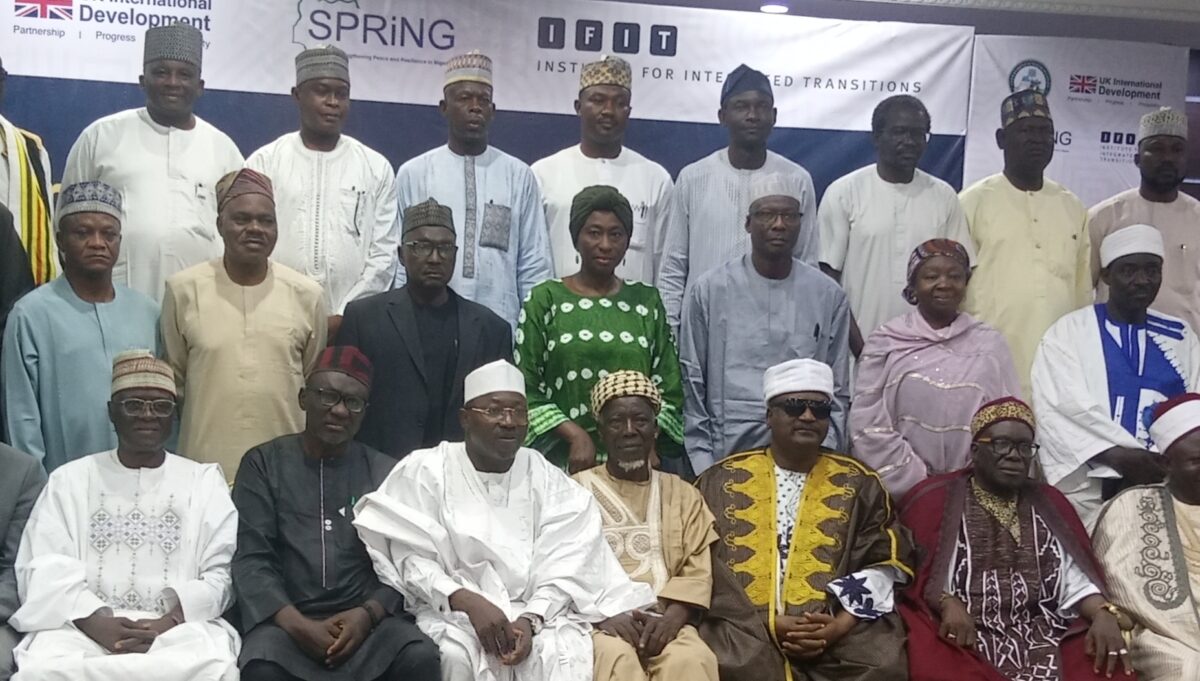
The presidency has stressed the need for a multi-stakeholders engagement and dialogue in building peace in conflict ridden communities across the country.
The Senior Special Assistant to the President on Community Engagement, North-Central, Abiodun Essiet said this
at the Institute for Integrated Transitions (IFIT) and the Middle Belt Brain Trust (MBBT) exchange workshop on peacebuilding and community recovery in Abuja on Thursday.
The workshop marked the conclusion of a phase of the IFIT’s Foreign, Commonwealth and Development Office (FCDO)-funded project of the United Kingdom International Development.
The initiative supported peacebuilding and recovery efforts in Toto local government area of Nasarawa state through the Strengthening Peace and Resilience in Nigeria (SPRiNG) programme.
Essiet called on the MBBT to champion such peace building process not just in Nasarawa state but accross the North Central geopolitical zone while the model be adopted in other parts of the country, considering the success story of Toto.
She said her office is working with with all the state governments in North Central to establish Peace and Reconciliation Commissions to avoid fire brigade approach in the event of communal conflicts.
The presidential aide said the approach showed how security agencies can even deploy both kinetic and non-kinetic method in addressing conflict and crisis situations accross the country.
“We are showing the security agencies the need to use the non-kinetic aspect. I’ve always shared this, that we need non-kinetic the way we need kinetic in North Central, we need both approaches to sustain and maintain peace in the North Central.
“I’m welcoming the IFIT to Bassa and other local governments that we’re expecting them to also support and see how we collaborate with other local actors to see how we can sustain peace,” she said.
Essiet warned against mixing politics with peace building initiatives, saying it is one of the things that have made the process unsustainable.
“I’ve always told my people, don’t bring politics into what I’m doing. The fact that I’m in APC, I still bring everybody at the table. You know, the political narrative or political way of doing peace initiative has been one of the ways that have not sustained peace.
“So, encourage your colleagues, Honourable Chairman, one of the takeaways for them is to separate themselves from the peace process and allow peace to work.
“Once you’re bringing actors and stakeholders together, you bring all the parties together, not only people who are loyal to your government, you want everybody at the table because the peace process affect the community, not just the party,” she added.
Also speaking, the Nasarawa State Governor, Abdullahi Sule, said traditional rulers, security agencies, international organisations and other stakeholders were responsible for the return of peace in the hitherto warring communities.
Represented by the Nasarawa State Commissioner for Information, Culture and Tourism, Dr Isaac Aboki, the governor said the job of peace building is a continuous process which the stakeholders must continue to support.
He pledged the continuous support and investment of the Nasarawa State Government in sustainable peace accross the state.
“After several years, when we sat down, it was easier to resolve some of the issues that separated us. Today we are lucky and we are happy that we are all sitting here, nobody is afraid of anybody. So I want to say congratulations to the people of Toto.
“Any effort to build sustainable peace will depend on community involvement and participation. So the Nasarawa State Government will continue to invest in security in our various communities in Toto and across all the local government areas,” Sule said.
He commended President Bola Tinubu for his support and establishment of more military units and formations in Nasarawa state and across the country.
“Our state has been very peaceful and we’re excited with these new formations across the country. We pray that we continue to sustain peaceful coexistence in our various communities.
READ ALSO:
- Stakeholders Push For Rights-Based Mental Health Care In Nasarawa
- IGP Suspends Wanted Declaration Against Obaigbena, Nestoil Boss, 7 Others
- Defence Minister Advocates Indigenous Technology Solutions For National Security
“We must continue as a local government, as individuals or whoever we are, we have to invest in peace so that our people can live together, develop their economies, their social well-being and all that is necessary for them to live and then develop themselves,” he added.
In his presentation, a former Chief of Defence Staff and chairman of MBBT, Gen. Martin Luther Agwai(Rtd) said the
Toto experience offerred valuable lessons, not only about resolving conflict but how government, traditional institutions, communities and development partners can work together to create conditions that sustain peace.
He said one of their most important strategic choices was to seek alignment and secure buy-in from the beginning, rather than introduce externally designed solutions and expect communities and institutions to adopt them.
The former defence chief said,
that required understanding not only the causes of conflict but also the interests, responsibilities and influence of the institutions and individuals capable of shaping its resolution.
He said they engaged government authorities, traditional councils, community leaders and other influential actors to build confidence, identify shared priorities and create a common basis for action.
Agwai stated that the central lesson was that sustainable peacebuilding must be rooted in locally recognised priorities, supported by legitimate institutions and owned by those responsible for Sustaining its outcomes.
“Our experience demonstrates that communities divided by violence can begin rebuilding trust, restoring cooperation and developing mechanisms for managing their differences.
“I wish to sincerely appreciate the FCDO for supporting this initiative, the Nasarawa State Government for its engagement, and our traditional councils, community leaders, women, young people and security institutions for their contributions,” he added.
On his part, Conflict Adviser at FCDO, Pirmah Rimdans said the project is a sign of the UK-Nigeria partnership that has existed for decades and is represented formally through the strategic partnership, especially in the security and defence collaboration signed in 2026.
According to him, peace must recognise the local capacities and institutions that exist, understand the history and context of conflict and come in various angles.
“There is no one method for peace. Peace is not only in the dialogue place, it’s also in the school yard, it is also in the hospitals, it is also in the livelihoods and the interactions that communities and groups face together.
“Whenever we can bring communities into interaction in a way that mutually benefits them, we believe that peace is a very plausible outcome of such interactions,” he said.
The Aguma of Bassa, HRH David Tukura noted that peace is a decision; must be promoted by committed leaders, enforced and it is a process, saying now that the people have embraced peace, government should come to their aid through the provision of basic amenities.
“Peace is a decision. You have to make up your mind that I’m not going to fight again. I will not resolve my issues through violence. Rather than to fight my brother, I’ll call him for a dialogue.
“Secondly, peace must be led. Without leaders, you cannot do peace. Peace is not a state of nature. I think the state of nature is chaotic. So somebody must be in charge or else you have no peace. So peace must be led.
“Thirdly, when found, peace must be enforced because there are people that benefit from chaos. They make, they derive benefits from the rumours, the violence, the chaos, the bloodshed. Something goes in somebody’s pockets. So you must enforce peace.
“The other thing we learned also is that peace is a process. You could have a long list of grievances but those grievances cannot be resolved in one day. Give it time. Take it step by step but be consistent and you will get there,” he stated.

