

The crisis became public on November 17, 2026, when a group identifying itself as the church’s Board of Trustees announced that it had withdrawn recognition of Jimmy as Senior Pastor and appointed Pastor Rotimi Okpaise as interim spiritual and administrative leader.
The group cited a December 2021 video in which the late Taiwo Odukoya reportedly named Pastor Kunle Areogun as his preferred successor, with Jimmy expected to serve as Areogun’s administrative assistant and head of the youth ministry. According to the trustees, the recording was not presented during the 2023 succession process and only came to their attention in late 2025.
Jimmy, however, said his father initially asked him to record the video before travelling to the United States for surgery but later requested that it be deleted after the surgery was successful. He also accused members of the board and his sisters of working together to remove him.
The church rejected the trustees’ announcement, insisting that Jimmy remained its duly appointed Senior Pastor and Chairman of the Board of Trustees.
The dispute subsequently moved to court. On November 18, the Lagos State High Court granted an interim ex parte order restraining Jimmy from presenting himself as the church’s Senior Pastor and spiritual head. The order was made without first hearing his response, and the substantive dispute remains unresolved.
When The Pulpit Becomes A Family Legacy
One example is American televangelist Bishop T.D. Jakes, founder of The Potter’s House in Dallas, Texas.
Under the arrangement, Jakes retained his position as Chairman of the Board and spiritual overseer, while Sarah and Touré became co-senior pastors.
David Abioye And The Question Of A New Beginning
Another example is Bishop David Abioye, who served as the first vice-president of Living Faith Church Worldwide, popularly known as Winners’ Chapel, founded by Bishop David Oyedepo.
His retirement did not end his ministry career. In May 2025, he unveiled Living Word Conquerors Global Assembly, also known as Conquerors Global Assembly.
However, Abioye’s departure followed the church’s retirement policy and should not be interpreted as a direct succession dispute with Oyedepo.
Would Adeboye Hand Over To His Son?
READ ALSO:
- 2027: Group Demands Protection For Women In Politics
- Police Reportedly Seal Fountain Of Life Church Amid Odukoya Leadership Tussle
- Nigeria, US Deepen Maritime Security Ties, Target Illegal Movement Of Strategic Goods
Pastor Enoch Adeboye, who has led the global church since 1981, has publicly rejected the idea that the ministry should automatically become a family inheritance.
In June 2026, he reportedly said that the church belonged to Jesus Christ and that nobody had the right to hand it over to a biological child. He has also maintained that God would reveal his successor.
His position raises an important distinction between recognising a spiritual calling in a family member and appointing that person simply because of their relationship with the founder.
Is It God Who Chooses The Successor?
For many Christians, the belief is that God chooses those who lead His church. Biblical examples often cited in discussions about succession include Moses and Joshua, as well as Elijah and Elisha.
However, even where a church believes God chooses its leaders, there must be a process through which that conviction is recognised and translated into an institutional decision.
Who confirms the calling? Who assesses the candidate’s character and capacity? What happens when a founder’s preference conflicts with the church’s constitution or the decision of its governing body?
An ideal handover should begin long before a founder retires or dies. It should involve preparing potential leaders, communicating the succession framework and ensuring that appointments follow the church’s constitution.
Ultimately, the church’s mission must remain bigger than the person occupying the pulpit.
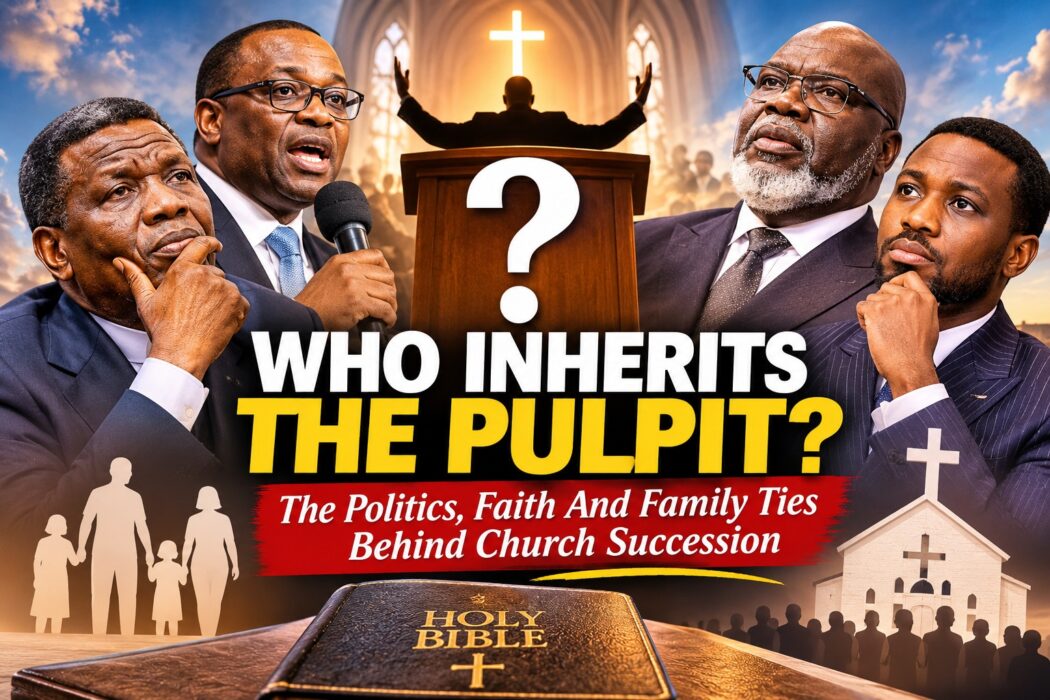
The experiences of Jimmy Odukoya, T.D. Jakes, David Abioye and Enoch Adeboye demonstrate that there is no single model of succession across Christian ministries.
But perhaps the most important consideration is not whether the successor shares the founder’s surname or has served under the founder for decades. It is whether the person is qualified to lead, whether the process is transparent and whether the church’s governing structure recognises the appointment.
The answer may determine whether the next generation inherits a thriving ministry or a succession crisis.

