

Ukraine has warned against the use of hunger as a weapon of war and political coercion, calling on the international community to protect global food security, safeguard maritime trade and ensure that historical atrocities such as the Holodomor never happen again.
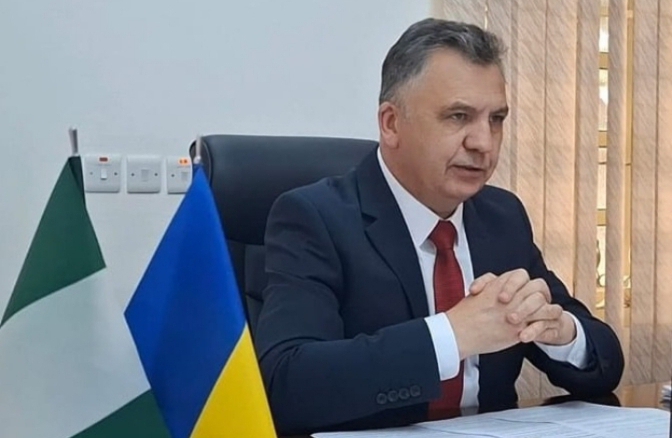
The warning was issued by the Ambassador of Ukraine to Nigeria, Ivan Kholostenko, in a statement marking the 93rd anniversary of the Holodomor of 1932–1933, one of the most devastating man-made famines in Ukrainian history.
Ukraine commemorates the victims of the Holodomor on November 28, alongside victims of the mass famines of 1921–1923 and 1946–1947, remembering millions of people who died under circumstances the Ukrainian government describes as deliberate and politically driven.
Kholostenko said the 1932–1933 famine was not caused by natural disasters but by policies implemented by the Soviet Union under Joseph Stalin, which resulted in widespread starvation, repression and the death of millions of Ukrainians.
According to him, the communist totalitarian regime deliberately sought to destroy Ukrainians as a nation capable of defending its right to an independent state.
He said forced food confiscation, restrictions on movement, the blockade of towns and villages, and widespread repression created conditions that made survival impossible for millions of people.
“The Holodomor was not the result of a natural disaster. It was the outcome of a deliberate policy pursued by Stalin’s regime,” the ambassador said.
He alleged that while millions of Ukrainians were dying of starvation, Soviet authorities continued exporting grain, rejected international humanitarian assistance and concealed the scale of the tragedy from the rest of the world.
The ambassador said the impact of the famine on children was particularly devastating, noting that in many districts of Ukraine, approximately two-thirds of schoolchildren did not return to their classrooms in September 1933.
He said the consequences of the national catastrophe remained deeply embedded in Ukraine’s collective memory and history.
The Holodomor of 1932–1933 was officially recognised under Ukrainian law in 2006 as genocide against the Ukrainian people.
Kholostenko said the remembrance of the tragedy had become increasingly significant in the face of what he described as renewed attempts to weaponise food amid Russia’s ongoing war against Ukraine.
He accused Russia of using its military aggression to deprive residents of towns and villages in temporarily occupied Ukrainian territories of access to food while also threatening international food security through disruptions to agricultural production and exports.
According to him, Russia has sought to block Ukrainian ports in the Black Sea since the beginning of its full-scale invasion, while systematically pillaging grain from temporarily occupied territories and facilitating its illicit export through what he described as a “shadow grain fleet.”
READ ALSO:
- Enugu Warns Residents Against Fraudulent Tax Demands, Disowns N1.5m Property Bills
- NLC Warns FG Against Delay Payment Of N70,000 Transport Allowance
- Bayelsa Boat Accident: Death Toll Rises To 32 As 28 Victims Get Mass Burial
He warned that further disruption of Ukraine’s maritime exports could reduce the global supply of grain, wheat, oilseeds and other agricultural commodities, with implications for countries dependent on food imports.
“Today, more than nine decades later, we are once again witnessing attempts to weaponise hunger,” he said, adding that Russia’s actions were not only affecting people in occupied Ukrainian territories but also threatening global food security.
The ambassador said Ukraine’s experience had demonstrated that food security depended on three critical factors: safe and unrestricted supply chains, strong and mutually beneficial partnerships, and a firm international stance against the use of food as a weapon.
Despite the ongoing war, he said Ukraine continued to contribute to global food security through humanitarian and food assistance programmes, including *Grain from Ukraine* and *Food from Ukraine*.
He said the initiatives had facilitated food deliveries to vulnerable countries across Africa, the Middle East and Asia, urging international partners to support and participate in the programmes.
Kholostenko called on the international community to ensure the safe and uninterrupted operation of the Ukrainian Maritime Corridor, strengthen the protection of civilian vessels and uphold freedom of navigation in the Black Sea.
He also urged countries to intensify efforts to combat the illicit trade in grain allegedly taken by Russia from temporarily occupied Ukrainian territories, warning that such activities undermined international trade and agricultural markets.
The ambassador stressed that the Holodomor should serve not only as a reminder of Ukraine’s painful history but also as a warning to the international community about the devastating consequences of allowing food to become an instrument of political pressure, domination or warfare.
He called on governments, international organisations and citizens across the world to reject the use of starvation as a weapon and take collective action to prevent similar atrocities.
“The international community must not allow such tragedies to recur anywhere in the world,” he said.
Kholostenko urged Ukrainians across the world, friends of Ukraine and others committed to human dignity to observe November 28 by honouring the victims of the Holodomor, observing a moment of silence and lighting a Candle of Remembrance.
He said preserving the truth about the past and ensuring that such crimes were never repeated was a shared responsibility of humanity.
“We remember the past. We protect the future,” the ambassador said.

