

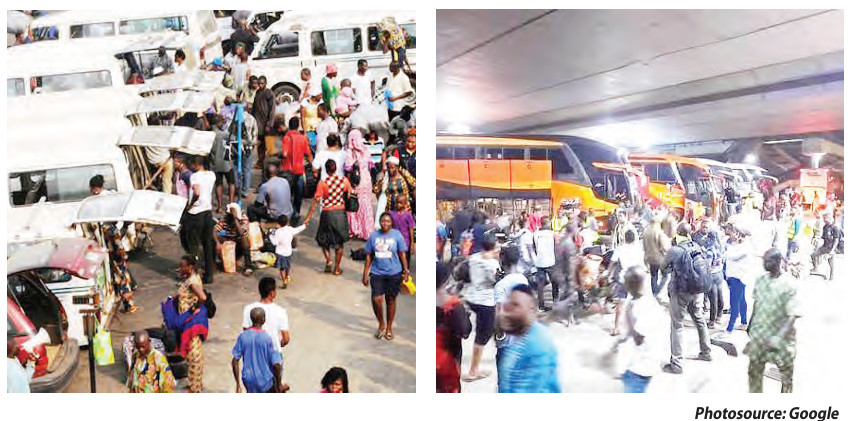
As Nigerians prepare to travel to their hometowns and other destinations for the forthcoming Christmas and New Year celebrations, concerns are mounting over the growing preference for night journeys despite repeated warnings by road safety authorities and security agencies about the dangers associated with travelling after dark. EJIKE EJIKE reports.
Every festive season, thousands of Nigerians embark on long-distance journeys to reunite with family members, attend traditional marriages, participate in community celebrations and observe religious activities.
For many, the journey home is an annual ritual that cannot be sacrificed, regardless of the challenges associated with road transportation.
However, increasingly, a significant number of these travellers are choosing to leave their destinations late at night or in the early hours of the morning, exposing themselves to risks ranging from fatal road crashes to armed robbery, kidnapping and other security threats.
From Lagos to the South-East, Abuja to the North-West, and Port Harcourt to other parts of the country, night buses have become a familiar feature of interstate transportation.
At major motor parks, passengers can be seen purchasing tickets for journeys scheduled to commence between 9pm and midnight, with some transport operators deliberately scheduling their long-distance services to arrive at their destinations early in the morning.
This trend has continued despite warnings from the Federal Road Safety Corps (FRSC), which has repeatedly advised motorists and passengers to avoid unnecessary night journeys.
The question, therefore, is why Nigerians continue to embark on night travels when the dangers have been repeatedly highlighted.
Is it simply a matter of convenience, economic hardship, poor road infrastructure, insecurity during the day or a combination of these factors?
The Federal Road Safety Corps has consistently maintained that night journeys expose motorists and passengers to considerable road safety risks.
The Corps Marshal, Shehu Mohammed, had issued a strong warning to fleet operators, commercial drivers and private vehicle owners against embarking on night journeys.
Mohammed described night travel as “not only unsafe, but utterly dangerous.”
He identified reduced visibility, driver fatigue, falling asleep behind the steering wheel and excessive speeding as some of the major factors responsible for fatal crashes during night journeys.
According to the FRSC boss, investigations and intelligence available to the corps indicated that some fleet operators and private vehicle owners engaged in night journeys for economic reasons.
He also raised concerns about vehicle overloading, including the transportation of passengers, animals and goods in ways that could expose road users to unnecessary danger.
Mohammed acknowledged that the FRSC did not have the legal authority to impose a blanket ban on night journeys but urged Nigerians to reconsider their travel schedules and embark on journeys during daylight hours.
One of the major concerns raised by the corps is the difficulty of providing immediate assistance to victims of crashes that occur at night, particularly in remote locations outside the reach of rescue teams.
In other words, a crash that might have been survivable under circumstances where emergency assistance was immediately available could become fatal because of delays in rescue operations.
The FRSC’s concerns are also supported by its research publication, Night Journeys and the Increasing Road Traffic Crash, which identified economic considerations, business exigencies, lower transport fares and the desire to avoid daytime delays as some of the reasons Nigerians prefer travelling at night.
The document also identified multiple taxation and extortion by law enforcement personnel and road touts during the day as factors contributing to the growing preference for night journeys.
These findings suggest that the problem goes beyond individual decisions and is connected to wider economic and structural challenges within Nigeria’s road transportation system.
During the 2025 end-of-year travel period, the FRSC intensified public awareness on major highways expected to experience increased vehicular movement.
The corps identified speeding, reckless overtaking, driver fatigue, mobile phone distractions, overloading and poor vehicle maintenance as major factors contributing to road crashes.
The corps urged motorists to plan their journeys, observe speed limits, ensure their vehicles were roadworthy and avoid night travel where possible.
It also warned that no destination was worth losing a life over.
Dangers Of Night Travel
Road safety statistics between 2024 and September 2026 indicate that Nigeria continues to face a serious road accident crisis, with thousands of lives lost and tens of thousands of people injured annually.
In 2024, the country recorded 9,570 road accidents, resulting in 5,421 deaths and 31,154 injuries. The situation remained troubling in 2025, when accidents increased to 10,446, representing a 9.2 per cent rise. Although fatalities dropped slightly to 5,289, the number of injured victims increased to 33,400.
Between January and September 2026, another 7,156 accidents were recorded, claiming 3,445 lives and leaving 22,292 people injured. These figures suggest that road crashes remain a major public safety concern.
Of particular concern is the danger associated with night journeys. FRSC’s 2022 statistics (which are the latest available) showed that although only 24 per cent of road accidents occurred at night, they accounted for 29 per cent of road accident deaths. The fatality rate was 58 deaths per 100 crashes at night, compared with 44 deaths per 100 crashes during the day.
This suggests that night-time accidents are more likely to result in fatalities than daytime crashes. Poor visibility, speeding, driver fatigue, inadequate road lighting and delayed emergency response could contribute to the severity of such accidents.
Although the available 2024–2026 figures do not distinguish between daytime and night-time crashes, the historical data raise important questions about the safety of overnight journeys in Nigeria.
For thousands of Nigerians who depend on night buses to travel between states, the figures underline the need for stricter enforcement of speed limits, proper vehicle maintenance, adequate rest for commercial drivers and improved emergency response along major highways.
Security Risks A Major Concern
While the FRSC is primarily concerned with road safety, the Nigeria Police Force has repeatedly drawn attention to the security challenges confronting travellers, particularly during festive periods.
The risks include kidnapping, armed robbery, attacks by criminal gangs and other violent crimes along highways.
The Inspector-General of Police, IGP Olatunji Disu, has, in recent festive-season security directives, ordered enhanced security deployments across the country, including on highways, at motor parks and other public places.
READ ALSO:
- Real Reasons Young Nigerians Are Dumping Superstitions, Embracing Cats As Household Pets
- Nigerians Can’t Wait Five Years For Security, CISLAC, Others Tell Tinubu
- Hardship Pushing More Nigerians To Have Fewer Children
The IGP directed commissioners of police and tactical commanders to strengthen security deployments and intensify proactive policing throughout the celebration.
The operational measures included the deployment of tactical teams, intelligence operatives and conventional police personnel to highways and motor parks.
The police also announced intensified visibility policing, coordinated patrols, surveillance and intelligence-led operations to prevent criminal activities.
Although the announcement was not a specific blanket prohibition against night journeys, the deployment of personnel to highways and motor parks underscores the security concerns surrounding increased human movement during festive periods.
The force also urged members of the public to remain vigilant and report suspicious activities to security agencies.
The police position is particularly important because travelling at night can increase passengers’ exposure to criminal attacks, especially along isolated highways and routes with inadequate security presence.
Why Travel At Night
Despite the warnings, night travel continues to enjoy considerable patronage among interstate passengers.
Kelechi Korieocha, co-founder of PKO Transport and Logistics Company, said that passengers patronised night journeys because of the difference in fares.
He explained that during the festive period, daytime transportation could cost as much as N60,000, while passengers could secure night transportation for about N45,000.
This difference becomes significant for families travelling with several children or people who must make multiple journeys within a short period.
For a family of five, saving N15,000 per ticket could translate into N75,000 in transportation expenses.
That amount could otherwise be used to purchase food, clothes, household necessities or other items required during the festivities.
The owner of Bamayi Motors, Mallam Bamayi Mohammed, identified some reasons why people engage in night travel.
According to him, Nigeria’s economic situation remains one of the major considerations influencing passengers’ decisions. With the high cost of living, rising fuel prices and increased transportation expenses, many Nigerians are increasingly concerned about how much they spend travelling.
For some passengers, travelling at night is not necessarily their preferred option but an economic decision.
A passenger who has to travel with a spouse and three children may find the difference between daytime and night-time fares too substantial to ignore. Rather than spend more money on daytime transportation, such a passenger may choose a night bus, hoping to reach the destination before daybreak.
“Another major reason Nigerians prefer night journeys is the desire to avoid traffic congestion.
Several interstate highways experience significant traffic during the daytime, particularly during festive periods when commercial activities and human movement increase.
“Travellers using the Lagos-Ibadan Expressway, Lagos-Benin Road, Abuja-Kaduna Road and Abuja-Lokoja Highway, among others, sometimes spend several hours in traffic.
Construction activities, broken-down vehicles, security checkpoints, accidents and poor road conditions can further increase travel time.
“For some passengers, night travel offers a convenient opportunity to combine transportation with their daily activities. A person who closes from work in the evening can board a night bus instead of waiting until the following morning.
Similarly, traders can travel overnight, arrive at their destinations early and commence their businesses without necessarily losing an entire day.
Some passengers also prefer night journeys because of the relatively cooler weather.
“Unlike daytime journeys, when passengers are exposed to intense heat, night transportation can be more comfortable, particularly where air-conditioning facilities are inadequate.
Transport operators have equally capitalised on this preference by scheduling departures to enable passengers to arrive at their destinations early in the morning.”
Drivers Weigh Economic Survival And Personal Safety
Commercial drivers are among those most exposed to the dangers of night journeys.
Apart from poor visibility and the possibility of encountering criminal gangs, they must contend with fatigue, excessive speed, mechanical problems and difficult road conditions.
Some drivers work for extended periods before embarking on long-distance journeys.
Others may have little opportunity to rest between trips because of the pressure to meet operational targets.
He said, “If I refuse to drive at night, the next driver will take my passengers, and I will go home with nothing.”
He further explained that vehicle owners sometimes threaten to replace drivers who refuse night assignments.
“We are afraid of kidnappers, but we are more afraid of not feeding our families,” he said.
His comments expose an important dimension of the problem: drivers themselves may be unwilling participants in a transportation practice sustained by economic pressure.
The situation raises questions about the responsibility of transport companies to protect their employees and passengers.

