

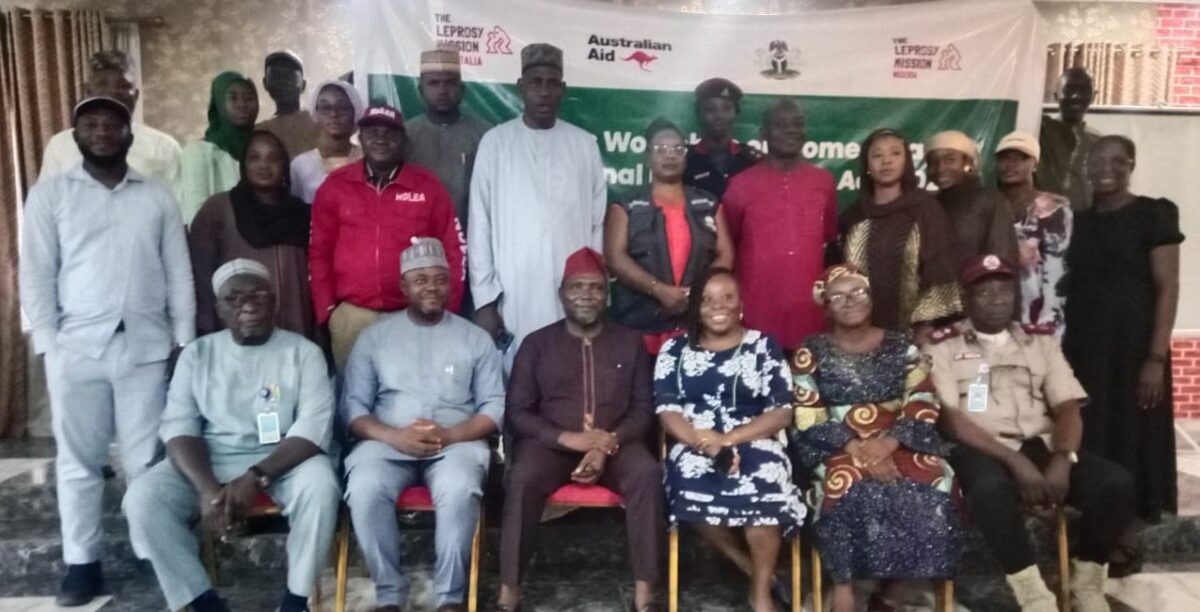
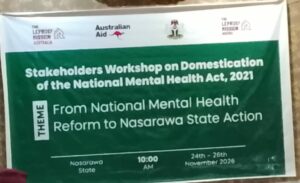
Nasarawa State has commenced a three-day workshop on the domestication, technical review and validation of the Mental Health Bill and Policy — a major step towards providing legal backing and rights-based care for persons with mental health conditions in the state.
The workshop, which opened on Tuesday in Lafia, brought together representatives of the Federal Ministry of Health and Social Welfare, the Nasarawa State Ministry of Health, the Ministry of Justice, the Nasarawa State House of Assembly, development partners, civil society organisations, persons with lived experience, caregivers, and the media.
Mental health can no longer be an afterthought.
Declaring the workshop which was sponsored by The Leprosy Mission, open, the Director of Public Health, Nasarawa State Ministry of Health, Dr. Peter Attah, said mental health could no longer be treated as an afterthought in the health system.
“We are here because mental health can no longer be treated as an afterthought in our health system. In Nasarawa State, too many of our people suffer in silence. Too many families carry the burden alone. Too many health workers do their best without a clear legal framework, without adequate policy backing, and without the tools to provide dignified, rights-based care,” Attah said.
He described the workshop as an opportunity to change the narrative, noting that it came at a very significant moment for the state.
According to him, just last week, the 67th National Council on Health concluded its meeting in Lafia under the theme “From Commitments to Results,” where the Council approved the integration of essential mental health services — for depression, anxiety, alcohol use disorder, epilepsy and psychosis — into Primary Health Care across the 36 states and the FCT.
“That is a clear national directive. Mental health is central to Primary Health Care, to Universal Health Coverage, and to the health of all Nigerians,” he said.
Attah explained that the three-day engagement was structured to move from understanding to action. Day One is devoted to building a shared understanding of the National Act, domestication and the mental health landscape in Nasarawa State.
He charged participants to be guided by three principles throughout the deliberations: Rights and Dignity, Practicality, and State Ownership.
On rights, he insisted that every provision must protect the dignity and human rights of persons with mental health conditions.
On practicality, Attah warned that a beautiful Bill that cannot be implemented would be of no use, stressing that every clause must be aligned with what institutions can do, what the workforce can deliver, and what the budget can sustain — while still being ambitious.
On ownership, he said that although partners were welcome, final decisions and accountability rest with the Government and people of Nasarawa State.
READ ALSO:
- Nasarawa Targets Improved Healthcare Access With 3,000 New Health Workers
- Bauchi, UNICEF Launch 2nd Round Of 2026 Maternal, Child Health Week
- Senate Moves To End 50-Year Army Land Dispute With Ogun Communities
He said the state’s culture, multilingual nature, and multi-religious character must be factored into the Bill and Policy.
He also disclosed that after the workshop, a smaller validation session involving about 10 key stakeholders, including the House of Assembly and Ministry of Justice, would be convened to finalise the Bill before transmission to the State Executive Council for ratification and onward passage to the House of Assembly.
Also speaking, the Lead Facilitator, Dr. Ameh Zion Abba, said the workshop, supported by TLMN, was aimed at ensuring Nasarawa State domesticates the National Mental Health Act 2021 and develops its own Mental Health Policy.
“Mental health is no longer a sidelined subject in the health sector. It has become paramount. It is a governance issue. It is a human rights issue, and everyone living with a mental health condition, illness, or disorder must have their care prioritised,” Abba said.
He said Day One was focused on helping participants understand the key provisions, rights and dignity enshrined in the National Mental Health Act, so they can understand the rights of Nasarawa State indigenes.
Abba noted that several states, including Lagos, Kaduna and Ekiti, have already domesticated the Act, while Benue State is currently being piloted by TLMN. He said Nasarawa was now joining the list, not as a political achievement, but for the wellbeing of the people.
He described the mental health burden in the state as a cause for concern, citing cases of depression, anxiety disorders, panic attacks, schizophrenia, substance use disorders, and postpartum depression among pregnant women.
“There cannot be health without mental health. It is of necessity that issues like these, in terms of policies, legislations and frameworks, happen because we have people in Nasarawa State coming down with mental health disorders,” he said.
3 Health Workers Die Of Tuberculosis In Nasarawa As Drug-Resistant Cases Rise
He added that the domestication would also provide a framework for mental health financing at the state level, increased budgetary allocation, research and data, and improvement of the mental health workforce.Drug Resistance: WHO Seeks Urgent Action Across Health, Agriculture, Environment Sectors
Abba listed stakeholders at the workshop to include officials from the Federal and State Ministries of Health, Ministry of Education, Health Management Board, Primary Health Care, NDLEA, Road Safety, civil society organisations, religious leaders, NGOs and persons with lived experience.
He said religious leaders were critical stakeholders because they are often the first point of call for many people, and must be well-informed on policies and rights.
Attah urged participants to be open, honest, and practical in their deliberations.
“Speak. Contribute. Challenge where necessary. Build consensus where possible. Let us leave here with a validated Bill, a validated Policy, and a clear roadmap,” he said.

