

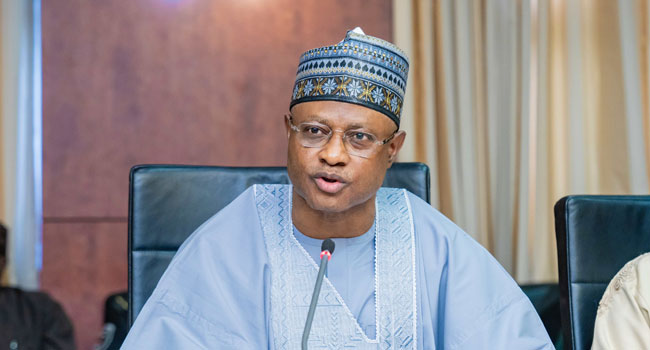
Governor Uba Sani has said that he took over a Kaduna State that had a lot of potential but also had problems with security, infrastructure, and social indicators that needed to be fixed right away.
The Governor spoke at a workshop for high-ranking government officials put on by the Nigerian Institute of Public Relations (NIPR) as part of the ongoing Nigeria Public Relations Week, Croc City 2026, which is taking place in Kaduna.
The theme of the workshop was “From Policy to Public Trust: Strategic Communication for Vision Alignment and Governance Delivery for Renewed Hope.” It was attended by senior government officials, such as commissioners, special advisers, counselors, and permanent secretaries.
Governor Uba Sani said at the event, “Kaduna is not where it was.” Kaduna is a much better place now, and what’s even more exciting is that it is moving forward and getting ready to do even bigger things and reach even higher heights.
He said that his administration knew from the start that small changes wouldn’t get the State to where it wanted to be. Instead, it needed a disciplined reorientation of how government works.
He said that his government then promised that the vision would have to have a measurable effect or it would stay a dream.
“We made a performance framework based on Key Performance Indicators a part of our institutions. This makes sure that every ministry, department, and agency knows what it is supposed to do and is responsible for the results,” he said.
The Governor said that when he took office in 2023, he also based his agenda on seven strategic pillars. The results have been good in the last two and a half years.
He said that the seven pillars are safety and security, building infrastructure, making institutions stronger, trade and investment, agriculture, developing human capital, and getting citizens involved.
Governor Uba Sani said that these pillars are not separate goals, but “interconnected levers” that are meant to work together as a whole system. Each one supports the others and helps to achieve a bigger goal: making Kaduna State a safe, prosperous, and welcoming place to live.
He said that security is the basis for all progress and that without it, “farmers can’t work their land, businesses can’t invest, and communities can’t grow.”
The Governor said that he worked closely with the Office of the National Security Adviser and the military high command to set up new military bases in dangerous areas like Giwa, Birnin Gwari, and Southern Kaduna.
“We made it easier for security agencies to move and respond by giving them more than 150 operational vehicles and 500 motorcycles. He went on to say, “In our cities, we formed a Joint Task Force that has greatly cut down on street crime and banditry in general.”
Governor Uba Sani also said that his government was focused on structural outcomes.
“We have taken back more than 20,000 hectares of farmland that was previously hard to reach. This has allowed farmers to get back to work, especially in places like Birnin Gwari, Giwa, and Kargarko.
“We have helped over 1,000 displaced people find new homes and are still giving targeted help to more than 117,000 internally displaced people, with a focus on women and children,” he said.
The Governor also said that his government has built the first forensic lab in Northern Nigeria, which has made it easier to investigate crimes.
The Kaduna Incident Report Centre, or KAD-IR, now offers a 24-hour platform for emergency response in real time. He said, “There are early warning systems in place to find and calm tensions before they get worse.”
He says that Kaduna State has made peace talks a regular part of its government, set up local peace councils, and put in place a framework for rehabilitation and reintegration that puts learning new skills ahead of money as part of its non-kinetic strategy.
He said that even though the outcome isn’t perfect, “security is getting better, confidence is coming back, and economic activity is slowly growing in places that were once thought to be off-limits.” We now call this the Kaduna Peace Model, which sums up everything.
Governor Uba Sani also said that his government has made great progress in education by making planned investments to make it easier for people to get to school and raise the quality of education.
“We built 736 new classrooms and fixed up more than 1,200 old ones.” “We have hired 10,000 teachers and trained more than 33,000 education workers in new ways of teaching and using technology,” he said.
The Governor said that “one of our biggest successes has been the drop in the number of children who are not in school,” which went from about 550,000 to 187,720 in two years.
He went on to say, “This progress shows that there is not only investment, but also coordination, data-driven interventions, and ongoing involvement with communities.”
Governor Uba Sani also said that his government is making sure that education meets the needs of a modern economy.
“The creation of the Institute of Vocational Training and Skills Development is a big step toward closing the gap between education and work.
“By teaching our young people about ICT, mechatronics, renewable energy, and other fields that are in high demand, we are getting them ready for more than just jobs,” he said.
The Governor also said that in the last two and a half years, he has made it easier for people to get medical care, made health facilities better, and made systems stronger.
“We have improved 255 Primary Healthcare Centers to Level-2 status and set up 23 Centers of Excellence, one in each Local Government Area.” “We have built a 300-bed specialist hospital to provide advanced medical services in the state, which cuts down on the need for expensive medical travel,” he said.
He said that his government has started about 150 road projects that will cover more than 1,300 kilometers in all 23 Local Government Areas.
He said that the projects “are part of a deliberate strategy to connect rural production centers to urban markets, to cut down on travel time, and to boost trade.”
The Governor said that he has raised the agricultural budget from ₦1.48 billion in 2023 to over ₦74 billion this year. He has also given farmers over 900 trucks of fertilizer and signed up more than 100,000 smallholders for crop insurance to protect them from risk.
He went on to say, “We are moving from subsistence farming to value-added agribusiness through the Special Agro-Industrial Processing Zones in Chikun and Kubau. This will create jobs, raise incomes, and improve export potential.”
He says that Kaduna State has made it possible for growth to happen in the private sector.
He said that between 2023 and 2025, his government made 23 investments worth more than $743 million in important areas like agriculture, manufacturing, energy, and more.
We have also come up with a plan for investments worth about $2.77 billion. “This brings our total investment portfolio to over $3.5 billion, which is a clear sign that confidence in Kaduna is growing,” he said.
The Governor also said that his government has made a lot of progress in social protection and inclusion by opening more than 2.5 million new bank accounts for people who don’t have enough money to open their own.
He said that his government has given more than ₦18 billion in targeted help to families, farmers, and small businesses.
“Our free CNG mass transit program has already helped more than 1.4 million passengers by lowering the cost of transportation and making things easier for families,” he said.
Governor Uba Sani said, “Through Project 255, we are guaranteeing ₦100 million in public investment to each ward, making sure that development reaches every community, both urban and rural.”

